


An EPC contractor may have a fixed tower erection date, but that does not mean the tower manufacturer has a complete production-ready package. Drawings may still be under review, steel procurement may depend on final material grades, and galvanizing or inspection slots may not yet be confirmed.
These gaps can create schedule pressure long before the first tower member reaches the fabrication line.
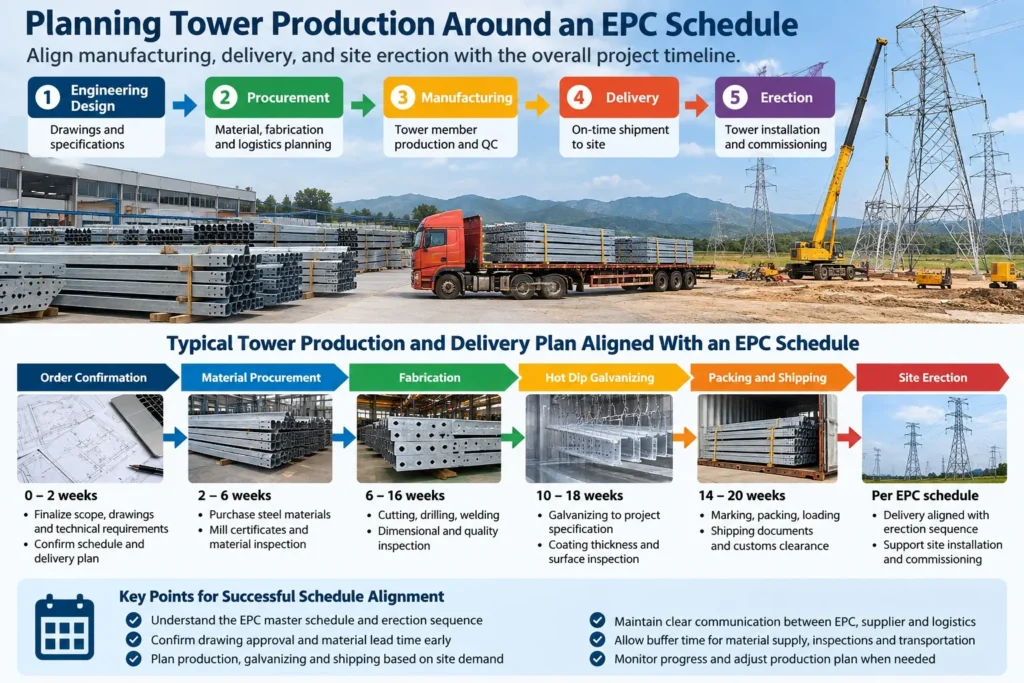
A reliable transmission tower production schedule must connect engineering release, material availability, fabrication capacity, quality inspection, and shipment sequencing to the EPC construction plan. The objective is not simply to manufacture towers quickly. It is to deliver the correct, complete, approved tower packages when the site can actually use them.
Quick Answer: How Should Tower Production Follow an EPC Schedule?
A transmission tower production schedule should be developed backward from the EPC project’s required site delivery and erection dates. The plan must include drawing approval, bill of materials confirmation, raw material procurement, trial assembly where required, fabrication, galvanizing, inspection, packing, and transportation. EPC contractors should divide production into controlled delivery batches based on construction priorities rather than treating the entire tower order as one shipment. Each batch needs defined technical release conditions, production milestones, inspection requirements, and dispatch dates. Schedule updates should reflect actual progress, engineering changes, material constraints, and site readiness.
1. Why Does an EPC Schedule Need a Separate Tower Manufacturing Plan?
An EPC master schedule typically coordinates engineering, procurement, civil works, foundations, access roads, transmission tower erection, conductor stringing, and commissioning.
Tower manufacturing is only one part of that larger sequence.
However, it has several dependencies that can affect construction progress:
- Engineering drawings must be sufficiently approved for the intended production activities.
- Required steel grades and sections must be available.
- Fabrication resources must match the quantity and complexity of tower members.
- Galvanizing must be coordinated with completed fabrication batches.
- Inspection and witness activities must be completed before release where required.
- Finished tower packages must reach the correct construction locations.
A delay in any of these activities can affect later milestones.
For example, a manufacturer might complete the first 200 metric tons of steel members, but if those members do not form complete erection-ready tower sets, the EPC contractor may still be unable to begin the planned installation sequence.
Production progress measured in tons is not the same as erection readiness measured in complete tower packages.
The manufacturing plan should therefore be connected to both production output and site requirements.
2. Start With the EPC Construction Milestones
Before developing the manufacturing schedule, the EPC contractor should provide a clear delivery requirement.
This should identify not only the overall project completion date but also the dates when individual tower groups are needed at the site.
Information the Manufacturer Needs
| EPC Input | Why It Matters |
| Project execution schedule | Establishes the overall delivery window |
| Tower erection sequence | Defines which towers are required first |
| Tower types and quantities | Determines fabrication workload |
| Approved drawing release dates | Controls production readiness |
| Site locations and access conditions | Influences shipment sequencing |
| Required delivery batches | Establishes dispatch priorities |
| Inspection and witness requirements | Affects release milestones |
| Destination and shipping method | Determines logistics planning |
| Required document submission dates | Prevents administrative shipment delays |
Information the Manufacturer Needs
The EPC contractor should also identify the activities that cannot proceed without specific tower packages.
For example, a river-crossing tower or a structure at a critical line-angle location may be more important to the construction sequence than several standard suspension towers.
Manufacturing priority should reflect these construction dependencies, not just the order in which tower drawings were issued.
3. Build the Transmission Tower Production Schedule Backward
Backward scheduling begins with the required site delivery date and works toward the earliest activities needed to support it.
A simplified sequence is:
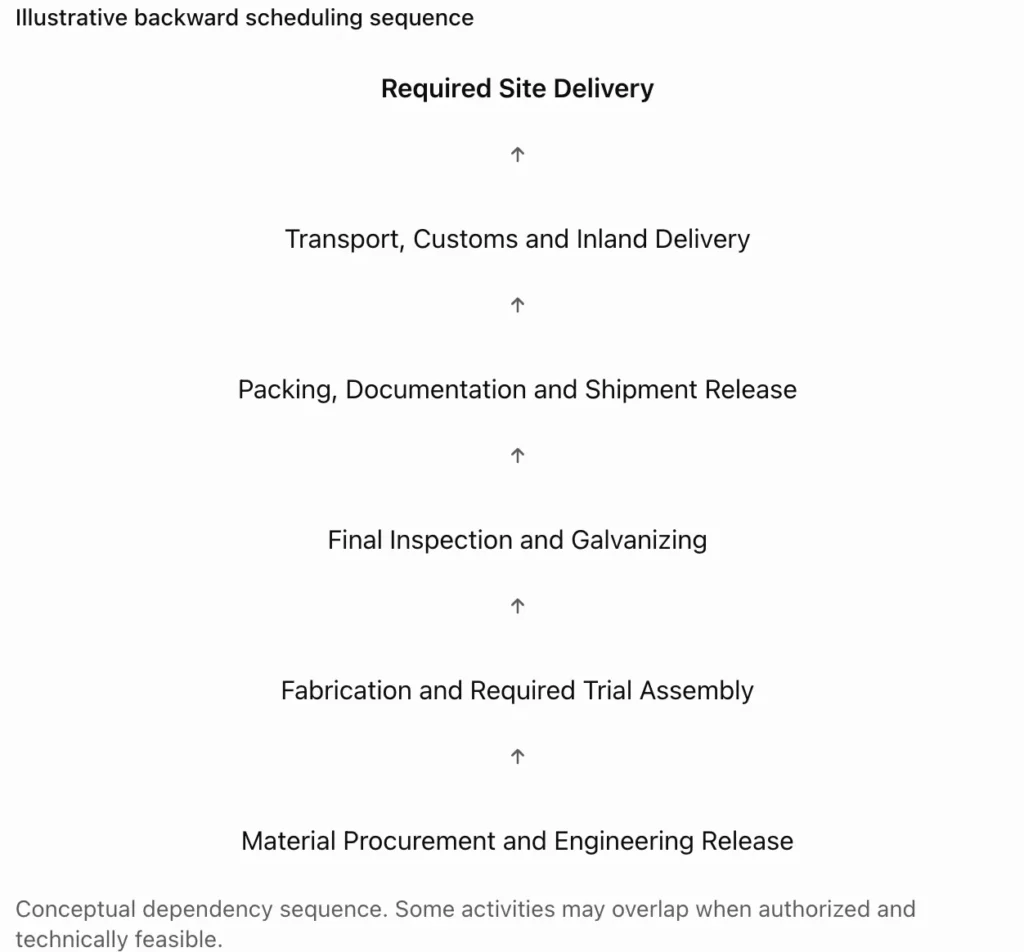
The manufacturer should estimate each activity using the actual scope, resource availability, approval process, and logistics conditions.
A planning model can be expressed as:
Where:
- Dstart= latest feasible start date for the defined work package
- Dsite= required site delivery date
- Trequired = total time along the controlling sequence of activities
The total duration must account for permitted overlaps, dependencies, calendars, inspection holds, and agreed schedule contingency. Simply adding every activity duration can overstate the required time if some activities legitimately overlap.
The calculation is a planning framework, not a substitute for a resource-loaded project schedule.
4. Do Not Schedule Fabrication Before Engineering Is Ready
One of the most common sources of manufacturing disruption is releasing incomplete or changing drawings into production.
Transmission tower fabrication depends on controlled information such as member sizes, steel grades, connection details, hole locations, bolt specifications, tower extensions, and member identification.
If those details change after cutting or drilling, the result may include scrapped components, rework, replacement material, or delayed galvanizing.
The American Institute of Steel Construction’s Code of Standard Practice discusses approval documents and fabrication release for its defined structural steel scope. Its principles are useful for coordination, although the code should not automatically be treated as the governing transmission tower specification.
Establish Clear Engineering Release Gates
For each tower type or manufacturing batch, the EPC contractor and manufacturer should agree on:
- The drawing revision authorized for manufacture.
- The approved material and connection specifications.
- The status of technical queries and deviations.
- The corresponding bill of materials revision.
- The party authorized to release fabrication.
- The process for handling subsequent design changes.
An approved drawing register should be linked to the production schedule.
When a revision is issued, the manufacturer should identify which members are not started, in production, completed, galvanized, or already shipped.
This allows the project team to assess the actual impact rather than automatically applying a revised drawing to every production stage.
5. Coordinate Steel Procurement With Production Priorities
Material procurement can become a critical schedule constraint when tower designs require different steel grades, thicknesses, sections, or plate dimensions.
The manufacturer should convert approved material requirements into a procurement plan that identifies:
- Required material specifications and quantities.
- Available inventory and material already committed to other orders.
- Supplier confirmation and expected receipt dates.
- Material certificate and traceability requirements.
- Receiving inspection and material release status.
- Shortage risks affecting priority tower batches.
A high-priority tower cannot be completed merely because most of its steel is available.
One missing angle size or connection plate material can prevent the completion of an entire tower set.
For this reason, EPC teams should ask for a material readiness report by tower type or delivery batch, not only a summary of purchased tonnage.
Where early material purchasing is proposed before final engineering approval, the parties should explicitly allocate the risk of subsequent design changes.
6. Match Fabrication Capacity to Tower Complexity
Production capacity should be evaluated against the actual fabrication workload.
Two orders with the same steel weight may require different manufacturing time because of differences in member quantity, hole patterns, connection details, cutting operations, welding requirements, and inspection complexity.
A useful production plan should distinguish:
| Production Activity | Scheduling Consideration |
| Material preparation | Steel availability and identification |
| Cutting | Member quantity, lengths, and processing sequence |
| Hole making | Hole patterns, tooling, and dimensional verification |
| Welding, where applicable | Joint complexity, procedures, and inspection |
| Trial assembly | Scope, readiness, and correction time |
| Batch release | Completion and acceptance of required checks |
| Transfer to galvanizing | Batch completeness and coating process availability |
The manufacturer should identify potential bottlenecks rather than applying a single average production rate to every tower type.
Why Trial Assembly Needs Its Own Schedule Allowance
Trial assembly, when specified, helps verify the physical fit of representative members and connections before extensive repetitive production.
It can reveal issues involving member geometry, connection fit, hole alignment, or interpretation of fabrication drawings.
The production plan should reserve time for assembly, inspection, issue resolution, corrective action, and approval to proceed.
Trial assembly is not automatically required for every tower or every project. Its scope and acceptance criteria should follow the contract and applicable technical specifications.
7. Treat Galvanizing and Inspection as Scheduled Operations
Galvanizing should not be treated as an unlimited-capacity process that begins immediately after fabrication.
Actual scheduling depends on factors such as component dimensions, handling arrangements, batch composition, available coating capacity, and required inspection.
For projects specifying ISO 1461:2022, the standard addresses the general properties and testing of hot-dip galvanized coatings on fabricated iron and steel articles, including acceptance inspection, coating thickness, and renovation provisions.
The governing project specification must define applicable acceptance requirements, including any additional customer requirements.
Coordinate Inspection Hold Points Early
An inspection and test plan may require witness or hold points for:
- Material identification and verification.
- First-piece dimensional inspection.
- Trial assembly.
- Fabrication or welding inspection.
- Galvanized coating inspection.
- Final quantity and identification verification.
- Packing and shipment release.
The exact requirements depend on the contract.
For each hold point, the EPC team should confirm the notification period, responsible inspector, required evidence, acceptance criteria, and release authority.
A completed production batch that is waiting for inspection approval may still be unavailable for shipment.
8. Use Phased Deliveries Based on Erection Sequence
For large transmission line projects, shipping all tower materials together may be less useful than delivering controlled batches aligned with construction progress.
Phased delivery can reduce unnecessary site storage and help direct materials toward active erection areas.
However, it creates additional coordination requirements.
Compare Two Delivery Approaches
| Factor | Single Consolidated Delivery | Phased Delivery |
| Shipment coordination | Fewer dispatch events | More dispatch events |
| Site storage demand | Potentially higher | Potentially lower |
| Manufacturing flexibility | Focus on total order completion | Priority batches must be controlled |
| Construction alignment | Depends on site sorting | Can follow erection sequence |
| Documentation | Consolidated records | Batch-specific records |
| Main risk | Large volume arrives before use | Missing or incomplete priority batches |
A phased delivery plan should define exactly which tower sets, bolts, accessories, and documentation belong to each shipment.
Partial packages should be identified as partial. They should not be reported as complete erection-ready sets.
Prioritize Complete Tower Packages
Suppose an EPC contractor needs 30 towers for its first erection section.
The manufacturing priority should be the complete approved material packages for those 30 towers, including required fasteners and accessories, rather than simply the first available steel tonnage.
The batch release process should verify completeness against the approved bill of materials and packing records.
9. Track Milestones That Actually Predict Delivery
A production schedule becomes useful only when actual progress is measured against it.
Reporting overall percentage completion can conceal critical problems.
For example, an order might be reported as 80% fabricated by weight while several essential tower types remain incomplete.
A stronger progress report should include the following measures.
| Milestone | Evidence to Request |
| Engineering released | Approved drawing and revision register |
| Material ready | Receiving and material availability records |
| Fabrication started | Batch production status |
| Fabrication completed | Completed-member quantities and inspection status |
| Trial assembly accepted | Applicable inspection and release records |
| Galvanizing completed | Coating inspection and batch records |
| Packing completed | Verified packing lists and package identification |
| Shipment released | Required QC and commercial release documents |
| Dispatched | Transport documents and loading records |
| Delivered | Site receiving confirmation |
These milestones should be linked to planned dates, actual dates, forecast dates, and the responsible party.
The EPC contractor should also track schedule variance and identify the next activity that could affect the required delivery date.
A regular coordination meeting can review engineering releases, production constraints, inspection readiness, shipping arrangements, and corrective actions.
10. Manage Schedule Changes Without Losing Control
Changes are common in EPC projects. The problem is not the existence of change, but allowing changes to enter production without evaluating their consequences.
Typical examples include revised tower extensions, changed steel grades, additional tower quantities, altered site delivery priorities, and delayed witness inspections.
A controlled change process should record:
- The change request and affected drawing revisions.
- The tower types and production batches involved.
- The status of affected materials and members.
- Additional fabrication or procurement requirements.
- Quality and inspection implications.
- Revised shipment forecasts and potential costs.
- Required approvals before implementation.
If a priority shipment is threatened, the team may evaluate resequencing unaffected tower types, reallocating confirmed resources, or modifying logistics arrangements.
Such measures should be technically feasible and commercially agreed. They must not bypass required engineering approval or quality acceptance.
11. Understand the Cost of Schedule Acceleration
Accelerating tower production can involve more than adding labor hours.
Possible cost drivers include overtime, additional shifts, expedited material purchasing, subcontracted processing, repeated setup operations, extra inspections, premium freight, and inefficient shipment consolidation.
Acceleration can also increase coordination and quality risks if work is released before technical information is stable.
EPC contractors should therefore compare the cost of acceleration with the construction impact of late delivery.
A practical decision should consider the actual critical path, the cost of delayed erection, available schedule float, and the feasibility of the proposed recovery actions.
The lowest quoted fabrication price does not necessarily produce the lowest overall project cost if the delivery sequence does not support construction.
12. What Should EPC Contractors Ask the Tower Manufacturer?
Before accepting a manufacturing schedule, the EPC procurement and project controls teams should ask:
- Which drawing approvals are required before each production batch begins?
- How is the production plan linked to the approved bill of materials?
- What evidence supports the proposed fabrication and galvanizing durations?
- Which activities are likely to become capacity bottlenecks?
- How are material shortages and drawing revisions reported?
- How are trial assembly and third-party inspections scheduled?
- Can production and shipment progress be reported by tower type and erection section?
- How are bolts, accessories, and replacement members included in batch completeness checks?
- What is the escalation process when a delivery milestone is at risk?
- Who authorizes the final release of each shipment?
The answers should be supported by a proposed schedule, document register, inspection plan, and responsibility matrix.
A confident delivery statement without these supporting controls provides limited assurance.

13. Documents to Agree on Before Production Starts
The following documents help establish a common schedule baseline between the EPC contractor and tower manufacturer.
| Document | Main Purpose |
| Approved drawing register | Establish manufacturing revisions |
| Tower schedule and bill of materials | Define types, quantities, and member requirements |
| Manufacturing schedule | Define activity and batch milestones |
| Material procurement status | Track steel readiness |
| Inspection and test plan | Define acceptance and hold points |
| Trial assembly plan, if applicable | Establish fit-up verification |
| Delivery batch matrix | Connect tower sets to construction priorities |
| Packing and marking procedure | Support shipment completeness and traceability |
| Document submission register | Track required QC and shipping records |
| Progress reporting format | Maintain consistent schedule visibility |
These records should be maintained under revision control. Responsibility for preparing, reviewing, and approving each document should be established before execution.
14. Planning Tower Production With HSD Steelwork
For EPC contractors evaluating tower manufacturing support, HSD Steelwork can be contacted through its website to discuss project requirements and the information needed for production planning.
The discussion should begin with the approved or current project documents, required delivery sequence, inspection requirements, and logistics destination.
Manufacturing capacity, proposed lead times, available processes, and project-specific delivery commitments should be confirmed through HSD’s formal technical and commercial response rather than assumed from general industry guidance.
Request a Project-Specific Tower Production Review
To support a useful initial review, provide:
- Project location and delivery destination.
- Tower types, quantities, and estimated steel weight.
- Current drawings and technical specifications.
- Applicable material, fabrication, and coating standards.
- Required erection and delivery milestones.
- Proposed delivery batches.
- Inspection and witness requirements.
- Packing, transport, and site access constraints.
Contact HSD Steelwork: HSD Steelwork website to begin a project-specific discussion.
Frequently Asked Questions
1. How early should tower manufacturing planning begin in an EPC project?
Planning should begin while engineering, procurement, and construction milestones are being coordinated, before the required fabrication release dates. The exact timing depends on design maturity, material availability, manufacturing workload, inspection requirements, and transport duration.
2. Can tower production begin before all project drawings are approved?
Some work packages may proceed under an explicitly authorized partial release. However, fabrication should not begin on unresolved details that could affect dimensions, material specifications, or connections. The parties must agree on revision control and the risk of subsequent changes.
3. Is phased tower delivery always better than one shipment?
No. Phased delivery is useful when construction areas have different priorities or site storage is limited. Consolidated delivery may be more practical for smaller projects or where logistics costs dominate. The correct approach depends on erection sequence, shipment economics, and site readiness.
4. How should an EPC contractor verify actual production progress?
Request evidence by tower type and delivery batch, including drawing status, material readiness, fabricated quantities, inspection acceptance, galvanized quantities, packing completeness, and dispatch records. Weight-based progress alone is insufficient.
5. What usually causes tower production schedules to slip?
Common risks include late drawing approvals, engineering changes, material shortages, processing bottlenecks, trial assembly corrections, galvanizing constraints, inspection delays, and transport disruptions. Their actual impact varies by project.
6. What should be done if the first tower shipment is delayed?
Identify the controlling cause, verify which complete tower sets are available, assess the effect on the construction critical path, and evaluate approved recovery options. Update the delivery forecast and communicate the revised plan to the EPC project team.
7. Should bolts and accessories be included in the production schedule?
Yes. A tower package may be unusable for erection if required bolts, nuts, washers, or other specified accessories are missing. Their procurement, inspection, packing, and delivery should be included in batch completeness controls.