


A transmission tower RFQ can contain dozens of documents, but the basic quotation problem is simple: the supplier needs enough information to determine what structures are required, what loads they must resist, how they must be manufactured and protected, how many are needed, and where they must be delivered.
Incomplete inputs do not always prevent a quotation. They do, however, determine whether the result is a preliminary budget estimate or a technically defined commercial offer.

Quick Answer
To request a transmission tower project quotation, start with the project location, voltage level, tower types, quantities, approximate heights, applicable standards, available drawings, conductor and ground-wire data, design loading conditions, steel and galvanizing requirements, inspection requirements, delivery destination, and required schedule. If approved tower drawings and bills of materials already exist, provide them with the RFQ. If the towers still require structural design, provide the line configuration, loading criteria, conductor data, clearances, tower functions, and project specifications. The more clearly these inputs are defined, the easier it is to compare suppliers on the same technical and commercial basis.
Can You Get a Budgetary Quote Without Complete Tower Drawings?
Often, yes.
A buyer may still be able to request a preliminary or budgetary estimate when detailed fabrication drawings have not been completed. At this stage, useful minimum inputs include:
- Project country and site location
- Nominal voltage
- Line length or approximate project scale
- Tower types required
- Approximate tower heights
- Estimated quantity by tower type
- Applicable design standard or utility specification
- Available conductor information
- General wind, ice, seismic, or other environmental criteria
- Required corrosion protection
- Delivery destination
The quotation should clearly identify assumptions and exclusions.
A firm manufacturing quotation requires considerably more definition, particularly when the supplier is expected to fabricate directly from approved drawings and bills of materials.
1. Define the Project Scope First
Start the RFQ with information that establishes the commercial and technical boundary of the project.
State the project name, country, line voltage, approximate route length, project stage, buyer or EPC role, and intended supply scope.
The scope is especially important. A request for “100 transmission towers” is not enough to establish whether the supplier is pricing only fabricated galvanized tower steel or also bolts, step bolts, anti-climbing devices, tower signs, grounding attachments, templates, anchor components, packing, testing, or other accessories.
A clear scope prevents these items from appearing later as commercial variations.
2. Provide a Tower Schedule With Type and Quantity
The tower schedule is one of the most useful RFQ documents.
For each structure type, identify the function and quantity. Depending on the line design, this may include:
- Suspension or tangent towers
- Angle towers
- Tension or strain towers
- Terminal or dead-end towers
- Transposition structures
- Crossing towers
- Special towers
Include nominal tower height and available body or leg extensions where applicable.
Do not assume that two towers for the same voltage class will have similar steel weights. Tower geometry and weight can change significantly with conductor configuration, span, line angle, loading combinations, clearances and extension requirements.
A quantity such as “200 towers” therefore provides much less pricing information than a schedule showing the quantity of every tower family and extension combination.
3. State the Applicable Design Standards and Owner Specifications
The RFQ should identify the required structural design standard, overhead-line design criteria, material specifications, fabrication requirements, coating standard and project-specific utility specifications.
For example, IEC 60826:2017 establishes reliability-based loading and strength requirements for overhead lines. It also notes that local climatic data must be established for applying the framework and that detailed design of components such as supports is outside its scope. The tower design basis therefore needs more definition than simply stating “IEC compliant.”
For lattice steel structures, ASCE/SEI 10-15 is one example of a standard covering design, fabrication and testing requirements for members and connections in latticed steel electrical transmission structures.
Always identify the required edition or project-adopted version of a standard instead of assuming that every party is working from the same revision.
4. Provide Design Loads and Site Conditions

Where the supplier is responsible for tower design or verification, the RFQ should define the loading basis.
Relevant information may include:
Wind: design wind speed or pressure, reference conditions, terrain/exposure category and required load combinations.
Ice or snow: specified ice thickness or other project icing criteria where applicable.
Temperature: maximum, minimum and relevant conductor temperature conditions.
Seismic requirements: where required by the project or applicable code.
Altitude and terrain: particularly where these affect project criteria or electrical geometry.
Broken-wire and construction conditions: where required by the governing specification.
Longitudinal, transverse and vertical loads: if these have already been calculated by the line designer.
The safest procurement approach is to provide the approved loading tree, loading schedule or project design criteria rather than asking a fabricator to infer site loads from the project country alone.
5. Include Conductor, Ground Wire and OPGW Data
Tower loading cannot be separated from the line system it supports.
Where structural design is part of the supply scope, provide the conductor type and size, bundle configuration, number of conductors per phase, phase arrangement, ground wire or OPGW details, insulator arrangement, attachment points, relevant tensions and design spans.
Also identify the required ruling, wind, weight or equivalent span information used by the project designer where applicable.
For angle and terminal towers, specify the required line-angle ranges and termination conditions.
These inputs help define both structural loading and tower geometry. Missing conductor or attachment information can therefore affect much more than the cost of steel.
6. Send Approved Tower Drawings When They Already Exist
If the project has completed tower design, send the latest approved drawing package.
Useful documents can include:
- Tower outline or general arrangement drawings
- Shop or fabrication drawings
- Member schedules
- Connection details
- Bolt schedules
- Stub or base details
- Bills of materials
- Extension schedules
- Erection drawings
- Revision history
Clearly identify drawing status and revision.
Quoting against an obsolete revision creates an avoidable risk: the commercial offer may be based on one steel tonnage while the final approved tower contains another.
For procurement control, record the exact drawing and specification revisions used for the quotation.
7. Specify Steel, Fasteners and Corrosion Protection
The material specification affects both procurement and fabrication cost.
State the required steel grades or accepted equivalent standards, together with any project-specific material testing or traceability requirements.
Bolts, nuts, washers and other tower hardware should also have defined grades, coating requirements and applicable specifications.
For hot-dip galvanized fabricated steel, ISO 1461:2022 specifies requirements and test methods for coatings on fabricated iron and steel articles. ASTM A123/A123M is another commonly referenced specification covering hot-dip zinc coatings on iron and steel products. The RFQ should identify the standard adopted by the project rather than using only the phrase “hot-dip galvanized.”
If the project requires coating beyond normal galvanizing, such as a duplex system, state the complete coating specification and inspection criteria.
8. Define Inspection, Testing and Documentation Requirements
Quality requirements can change the quotation even when the steel tonnage stays the same.
Before pricing, identify whether the project requires:
- Mill certificates
- Material traceability records
- Mechanical test reports
- Dimensional inspection
- Welding inspection
- Galvanizing thickness records
- Trial assembly
- Prototype or full-scale tower testing
- Third-party inspection
- Inspection and Test Plan approval
- Hold or witness points
- Packing inspection
- Final manufacturing record book
ASCE/SEI 10-15, for example, addresses fabrication, testing, and quality assurance/quality control as part of its coverage for lattice steel transmission structures.
If third-party inspection or prototype testing is required, state who approves the inspection body, what is to be witnessed, and whether testing costs should be included in the base quotation.
9. Clarify Foundation and Tower Interface Responsibility
Foundation design is not automatically part of a tower supply quotation.
The RFQ should establish whether the tower supplier is responsible for tower steel only, stubs, base plates, anchor bolts, templates, foundation reactions, or any foundation-related design deliverables.
If foundations are designed separately, provide the required interface information and tolerances.
For an existing design, the tower-to-foundation connection should match the approved project drawings. For a new design, responsibility for reactions, anchor layouts and interface approval should be defined before detailed engineering starts.
10. Provide Packing, Delivery and Commercial Requirements
A technically correct tower price is not yet a complete delivered-project quotation.
State the required Incoterm, named delivery location or port, packaging requirements, marking system, shipping constraints and requested delivery schedule.
For international projects, useful commercial information includes:
- Quotation currency
- Required Incoterm
- Destination port or project location
- Requested shipment schedule
- Partial shipment requirements
- Packing and bundle limitations
- Documentation requirements
- Required quotation validity
- Payment-term requirements, if prescribed by the tender
For tower projects with several structure types, require piece marks and packing lists to remain traceable to the tower schedule. This reduces sorting problems when multiple tower types reach the erection site.
What Information Most Often Causes Quotation Differences?
Large differences between supplier quotations do not necessarily mean that one supplier has simply priced steel lower.
Check whether all bidders included the same tower types, steel weight basis, bolts and accessories, galvanizing specification, design responsibility, prototype testing, third-party inspection, documentation, packing and freight scope.
Also compare exclusions.
A lower quotation that excludes structural design, full-scale testing or destination freight is not directly comparable with a quotation that includes those items.
A bid comparison sheet should normalize these scope differences before commercial evaluation.
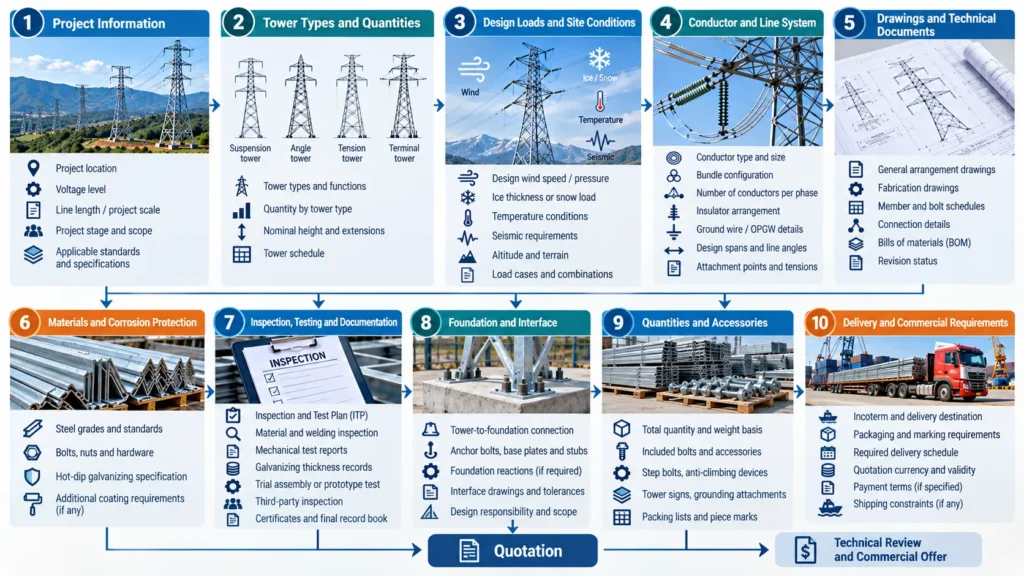
A Practical Transmission Tower RFQ Checklist
Before sending the inquiry, confirm that the RFQ answers these questions:
Project: Where is the project, what is the voltage level, and what is the supply scope?
Structures: What tower types, heights, extensions and quantities are required?
Design: Who is responsible for structural design, and which standards and project specifications apply?
Loads: Are approved load cases or design criteria available?
Line system: Are conductor, ground wire, OPGW, insulator and attachment data available?
Drawings: Are tower drawings and bills of materials available, and what are their revision statuses?
Materials: What steel, bolt and hardware specifications apply?
Corrosion protection: What galvanizing or coating specification applies?
QC: What inspections, tests, certificates and third-party requirements are required?
Logistics: What packing, marking, Incoterm, destination and delivery schedule apply?
If several answers are still unknown, identify them as open items instead of filling the RFQ with assumptions.
Information to Send HSD for a Transmission Tower Inquiry
HSD’s current product information identifies angle-steel and tubular transmission towers as part of its transmission tower range and states that project-specific design requirements can be reviewed against supplied specifications and drawings.
For an initial technical review, send the available project specification together with the tower schedule, drawings, loading criteria, conductor data, material and coating requirements, quantity, inspection requirements, destination and requested schedule.
If detailed drawings are not yet available, identify which engineering inputs are confirmed and which remain preliminary. This allows the quotation basis and outstanding technical questions to be separated clearly.
Request a Transmission Tower Project Quotation
A useful RFQ does not need to be a perfect document package. It does need to distinguish confirmed requirements from assumptions.
Send the project location, voltage level, tower types and quantities, available drawings, design criteria, conductor information, material and galvanizing specification, inspection scope, delivery destination and schedule. The technical scope can then be reviewed before commercial pricing is finalized.
FAQ
Can a transmission tower supplier quote without drawings?
A preliminary estimate may be possible using the voltage, tower types, approximate geometry, quantities, loads and other design inputs. A firm fabrication quotation normally requires substantially more detailed information or an agreed design scope.
Is voltage level enough to estimate transmission tower weight?
No. Towers at the same voltage can have different geometry and steel weights because of tower function, conductor arrangement, spans, line angles, loading conditions, clearances and extensions.
Should I send the bill of materials with the RFQ?
Yes, if an approved BOM is available. It helps define member quantities, material grades and the pricing basis. Always identify its revision.
What loading information should be included?
Provide the approved project loading criteria or loading trees where available, including applicable wind, ice, temperature, conductor, broken-wire and other specified load cases. Do not rely on the supplier to infer project loads solely from location.
Do I need to specify a galvanizing standard?
Yes. Specify the project-required coating standard and edition, such as ISO 1461 or ASTM A123/A123M where applicable, plus any project-specific coating or inspection requirements.
Should freight be included in a transmission tower RFQ?
State the required Incoterm and named destination. This makes it clear whether the supplier is pricing ex-works supply, port delivery, ocean freight, or another defined logistics scope.
What should I provide if the tower design is not finished?
Provide the confirmed design criteria: tower functions, electrical configuration, conductor data, spans, line angles, loading requirements, applicable standards, clearances, site conditions and required quantities. Mark preliminary information clearly so the supplier can state its quotation assumptions.