


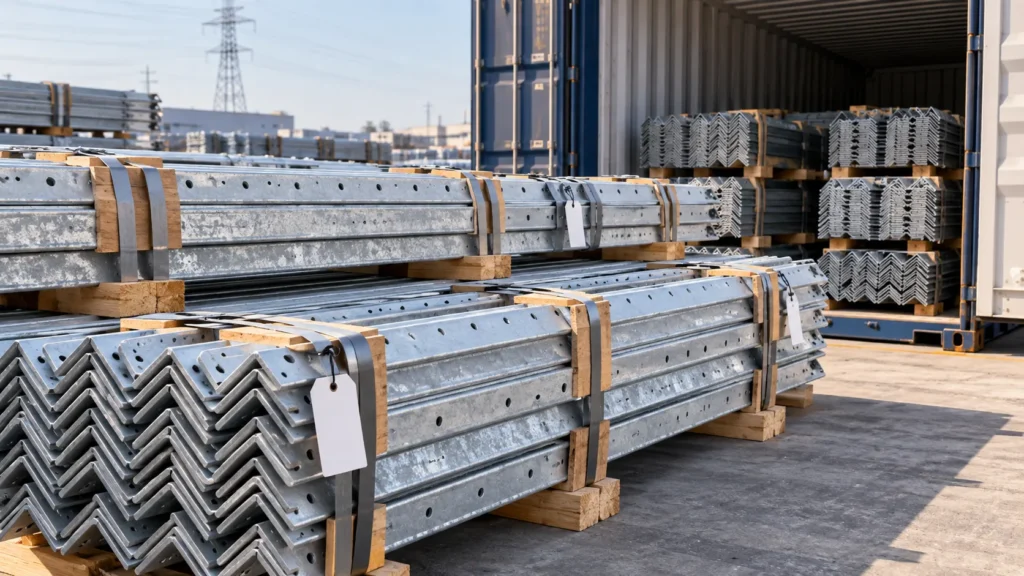
A transmission tower may contain hundreds or thousands of individual angles, plates, bracing members, bolts, and connection components. Once those parts have been galvanized, many look similar. The challenge for an export project is therefore not only protecting steel during transportation. Every member must remain identifiable from the packing yard to the erection site.
Poor marking can turn unloading into a search exercise. Poor bundling can mix tower types or erection sections. Inadequate packing can allow members to shift, rub, bend, or become difficult to handle during repeated transport.
For EPC contractors and utilities, tower member marking and packing should therefore be reviewed as part of the project’s traceability and logistics plan, not as an afterthought.
Quick Answer
Tower members for export should normally carry a durable identification mark that corresponds with the approved drawings, member schedule, or erection documentation. Members should then be grouped into manageable bundles according to an agreed packing logic, such as tower type, erection section, member type, or shipment sequence. Each bundle should have a clearly readable bundle identification linked to the packing list. Packing should protect galvanized surfaces, control movement during handling and transport, and allow safe lifting and unloading. If raw-wood pallets, crates, or dunnage are used in international trade, applicable ISPM 15 requirements should also be checked for the destination country.
Why Member Identification Matters After Galvanizing
A tower drawing gives every structural member a specific function and position. At the erection site, workers need to translate those drawings into physical pieces of steel.
That process becomes much harder when the identification system breaks down.
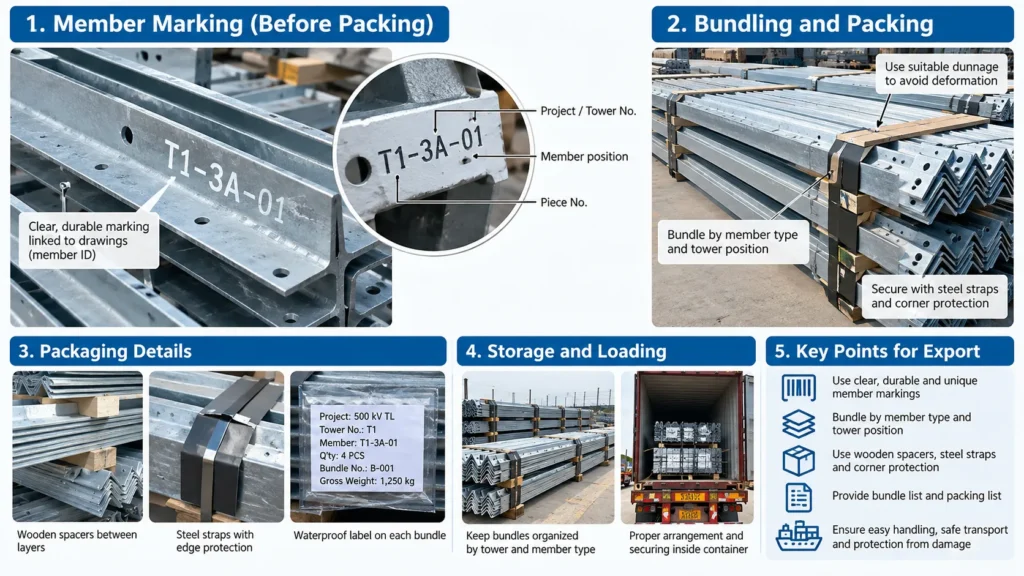
A practical member mark should correspond to the project’s controlled documentation. Depending on the project’s drawing and numbering system, the identifier may represent information such as:
- tower type or family;
- erection section;
- member position;
- individual member number; or
- another project-defined code.
The exact syntax should not be assumed. It should be agreed before production because different utilities, EPC contractors, and tower designers use different numbering conventions.
The key requirement is one-to-one traceability: the identification on the steel should allow the receiving or erection team to find the corresponding member in the applicable drawing or member schedule.
What Should Be Agreed Before Member Marking Starts?
The buyer and supplier should establish a marking convention before fabrication reaches the packing stage.
The agreement should answer practical questions: Which drawing or bill of materials controls the member number? Where will the identification be placed? What method will be used? Must the mark remain visible after galvanizing? Are additional tags required? How will identical pieces be identified? Are color codes permitted or required?
This matters because marking is not independent of manufacturing.
A mark that is clear before surface treatment may become difficult to read afterward. A loose tag can be lost during handling. An identification system used by the factory may also be useless at site if it does not correspond to the erection documentation.
For that reason, QC should verify the complete chain:
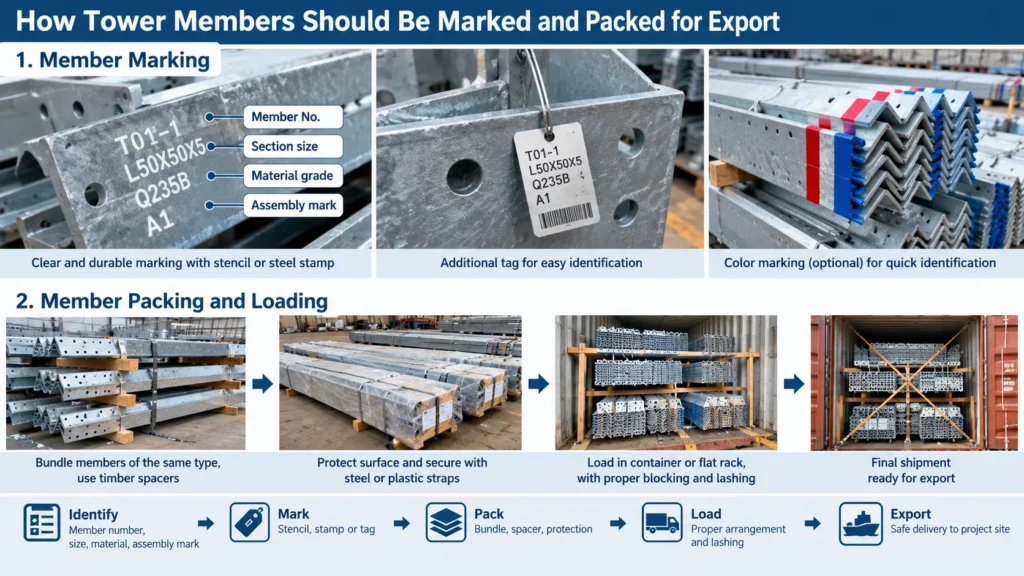
Approved drawing → member schedule → physical member → bundle → packing list.
If one link cannot be reconciled, the shipment is not fully traceable.
Member Marks Should Be Durable and Readable
The required marking method should be specified by the project rather than improvised during packing.
Depending on the technical specification and purchaser requirements, identification may involve permanent member marks, durable tags, paint or stencil identification, or a combination of methods.
Whatever method is selected, the buyer should verify three characteristics.
First, the mark must be legible. A code that technically exists but cannot be read after galvanizing or handling provides little site value.
Second, it should be durable enough for the expected logistics chain. Export tower steel can pass through factory handling, storage, trucking, port operations, sea transport, customs clearance, temporary storage, and site distribution.
Third, it must match the controlled project documents. Creating a second numbering system solely for packing can increase confusion unless there is a documented cross-reference.
Supplementary color coding may help crews distinguish tower families or bundles, but color should normally support rather than replace the primary member identification.
How Should Tower Members Be Grouped Into Bundles?
Packing logic should reflect how the material will be received and used.
Simply putting similar-sized steel angles together may improve packing density, but it can create additional sorting work at site. Conversely, organizing every bundle solely around erection sequence may reduce transport efficiency.
The project therefore needs a practical balance between logistics efficiency and erection usability.
Possible grouping criteria include tower type, tower number, erection section, member type, steel section size, shipment lot, construction sequence, or destination within the project.
For repetitive transmission line projects, the selected logic should be consistent throughout the shipment.
The packing specification should also establish bundle limits appropriate to the handling equipment and transport plan. Bundle dimensions and weights should not be chosen independently of forklifts, cranes, containers, trucks, unloading equipment, or site access restrictions.
Every Bundle Needs Its Own Identity
Individual member marking is only one level of traceability. The bundle itself should also be identifiable.
A useful bundle label or tag can include, where required by the project:
Project reference | tower type | bundle number | contents or member range | quantity | gross/net weight if required | package dimensions if required | shipment reference
The exact information should match the contractual packing specification.
Labels should be positioned so that they can be checked during storage and unloading without dismantling the bundle. For long bundles, duplicated identification at more than one accessible position can reduce problems when one side becomes obstructed.
The bundle number should correspond directly to the packing list.
This creates a straightforward receiving process:
Find bundle → check bundle number → check packing list → identify contents → distribute members.
Protect Galvanized Tower Members During Bundling
Hot-dip galvanizing provides corrosion protection, but galvanized steel should still be handled carefully during packing and transportation.
Bundles should be configured so that normal lifting and transport do not create avoidable deformation or concentrated contact damage. Suitable spacers, edge protection, and restraint can be used where necessary.
The packing design should consider:
Long slender members. They need appropriate support to reduce the risk of bending during lifting and storage.
Sharp corners and edges. Straps and contact points may need protection depending on the packing arrangement.
Small plates and fittings. These should not be allowed to disappear inside large structural bundles without clear identification.
Bolts and other small components. These generally require separate controlled packaging and identification appropriate to the project’s fastener schedule.
Water accumulation. Packaging and storage arrangements should consider drainage and ventilation rather than unintentionally trapping moisture against galvanized surfaces.
The objective is not necessarily to wrap every tower member completely. The appropriate protection depends on the product, voyage, storage conditions, contractual specification, and handling method.
Wooden Dunnage Requires Special Attention for Export
Timber is frequently useful as spacing or supporting material for long steel bundles. For international shipments, however, raw-wood packaging material can be subject to phytosanitary controls.
ISPM 15 covers wood packaging material made from raw wood used in international trade, including dunnage. Processed wood products such as plywood are outside the standard where processing has sufficiently eliminated pest risk.
Compliant regulated wood packaging carries the recognized ISPM 15 mark after approved treatment. IPPC guidance states that the mark must be legible, durable, non-transferable, and visible; the standard recommends marking preferably on at least two opposite sides of the wood packaging unit.
Therefore, an exporter should not assume that any available timber block can be used as international dunnage.
The destination country’s current import requirements should be checked before shipment.
Packing Marks and Handling Symbols
Outer packages may also need handling and storage information.
ISO 780:2015 specifies graphical symbols used on distribution packaging to communicate handling and storage instructions. ISO states that these symbols should be used when necessary; the standard does not cover dangerous-goods-specific handling instructions. The edition was reviewed and confirmed in 2026 and remains current.
For a tower shipment, the actual symbols required depend on the packaging and handling method. Buyers should avoid applying generic symbols merely for appearance. Markings should communicate an actual handling requirement.
Where project specifications prescribe package numbers, lifting information, center-of-gravity indications, destination marks, consignee references, or other shipping marks, these should be checked against the approved shipping documentation before loading.
Container Loading Is Part of the Packing Plan
A good bundle can still be damaged if it is poorly loaded.
The IMO/ILO/UNECE CTU Code provides international guidance on packing and securing cargo in cargo transport units and covers the intermodal transport chain. The IMO notes that inadequate securing, overloading, and incorrect declaration of cargo contents are among the problems associated with poor CTU packing practices.
For tower steel, the loading plan should consider bundle weight, length, support points, weight distribution, blocking, restraint, unloading sequence, container limits, and the forces expected during transport.
Cargo should not depend solely on its own weight to remain in position.
The specific securing arrangement should be determined by competent logistics personnel according to the actual cargo, CTU, route, carrier requirements, and applicable rules. The CTU Code is guidance rather than a substitute for a project-specific securing design.
What Should QC Check Before Shipment?
A pre-shipment inspection should connect physical material with documentation rather than checking packaging appearance alone.
A practical inspection can sample member marks against approved drawings, verify bundle numbers against the bundle list, reconcile package quantities with the packing list, inspect straps and supports, check for obvious transport-sensitive projections or loose components, review shipping marks, verify applicable wood packaging compliance, and record container or vehicle loading where required by the inspection plan.
Photos can also form part of the shipping record when specified by the purchaser.
The critical question is:
Can the receiving team identify what was shipped, where it is packed, and which drawing tells them where it belongs?
If the answer is unclear before the container doors close, the problem is likely to become more expensive after arrival.
Common Packing Problems Buyers Should Prevent
One recurring problem is mixed identification systems. Factory codes, drawing numbers, bundle numbers, and packing-list descriptions may each be understandable separately but fail to cross-reference.
Another is packing only for container utilization. Dense packing can reduce freight volume but may make unloading or site sorting inefficient.
A third is uncontrolled small components. Plates, bolts, and fittings need the same document discipline as large members.
Finally, unapproved wood dunnage can create an import issue unrelated to the steel itself.
These risks are easier to prevent when marking, packing, inspection, and logistics requirements are included in the purchase specification rather than discussed immediately before shipment.
Documents to Request With the Shipment
Depending on the contract, buyers may require a packing list, bundle list, commercial shipping documents, inspection records, material or coating documentation, bolt/package lists, and other project-specific records.
The document package should allow quantities and package numbers to be reconciled without opening every bundle.
ASTM D3951 is one example of a commercial packaging practice covering preservation, packaging, packing, unitization, and marking. Whether it applies to a particular tower contract depends on the purchaser’s specification; it should not be treated as a universal transmission-tower packing requirement.
Information to Include in a Tower Packing Specification
Before ordering, provide the supplier with the project identification system, approved drawings or member schedules, tower types and quantities, preferred bundle logic, maximum package restrictions where applicable, destination country, transport method, container or loading constraints, site unloading conditions, marking requirements, required shipping marks, wood-packaging requirements, documentation requirements, and inspection or witness points.
This information allows the packing method to be planned before production reaches the shipping yard.
For related RFQ preparation, see information required for a transmission tower quotation.
HSD Steelwork and Export Tower Projects
For a transmission tower inquiry, the packing and marking requirements should be reviewed together with the technical and commercial scope rather than added after fabrication.
When requesting a quotation from HSD Steelwork, buyers can provide tower drawings, member schedules, tower types, quantities, applicable specifications, destination, required identification convention, packing requirements, inspection requirements, and shipment plan.
This allows the requirements to be evaluated against the actual project scope before an offer or production arrangement is confirmed.
Send your tower drawings and packing requirements to discuss the applicable project requirements.
FAQ
Should every transmission tower member have an identification number?
The project should define the required traceability system. For tower members that must be matched to drawings or erection schedules, durable individual identification is generally valuable for receiving, sorting, and erection control.
Can different tower types be packed in the same bundle?
This depends on the approved packing plan. Mixing tower types may improve loading efficiency in some cases but can increase site sorting risk. The bundle contents must remain clearly identifiable and traceable.
Should tower members be completely wrapped for sea freight?
Not automatically. The protection method should reflect the galvanized product, transport route, storage conditions, handling method, and contractual packing specification. Moisture drainage and ventilation should also be considered.
Does ISPM 15 apply to the galvanized steel?
No. ISPM 15 concerns regulated wood packaging material associated with international trade, not the steel product itself. Raw-wood pallets, crates, blocks, or dunnage may fall within its scope.
What should be shown on a tower bundle label?
Project requirements vary, but useful information can include the project reference, tower type, bundle number, member range or contents, quantity, weight where required, and shipment reference.
What should buyers inspect before container loading?
Check member and bundle identification, packing-list reconciliation, bundle integrity, supports and restraints, applicable wood packaging requirements, shipping marks, cargo arrangement, and required shipment records before the cargo leaves the factory.