


Choosing a transmission tower manufacturer is not simply a matter of comparing price per ton. For a utility or EPC contractor, the supplier must convert approved drawings and project specifications into thousands of identifiable steel members, plates, bolts, and assemblies that fit together correctly in the field.
A low quotation can become expensive if hole positions are wrong, members arrive without reliable identification, galvanizing does not meet the specified requirement, documentation cannot be traced to production batches, or packing makes site erection unnecessarily difficult.
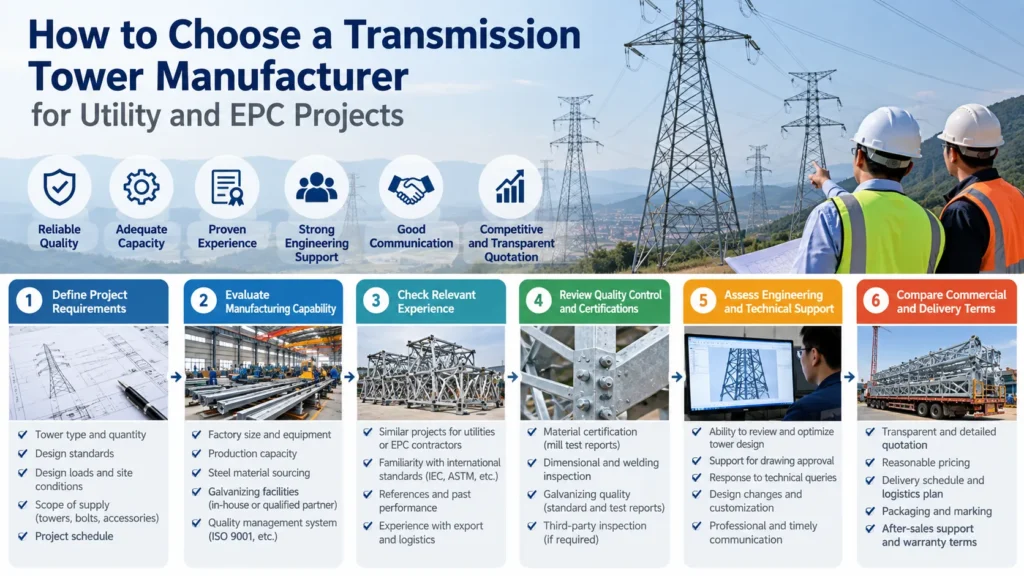
The practical question is therefore not just, “Can this factory manufacture transmission towers?” It is: Can the manufacturer demonstrate control from drawing review and raw material receipt through fabrication, galvanizing, inspection, documentation, packing, and shipment?
Quick Answer
A utility or EPC contractor should choose a transmission tower manufacturer by verifying project-specific manufacturing capability rather than relying on price, factory size, or certificates alone. Review the supplier’s experience with the required tower type and specification, drawing control, material traceability, fabrication and hole accuracy, welding procedures where applicable, hot-dip galvanizing controls, trial assembly or tower testing requirements, inspection records, identification and packing systems, and document turnover. The RFQ should also define applicable standards, inspection hold points, required certificates, quantities, delivery sequence, and site destination before quotations are compared.
Start With the Project Requirements, Not the Factory Brochure
Before comparing manufacturers, define what the project actually requires.
Transmission line requirements vary by voltage, tower family, loading system, environmental conditions, national regulations, utility practices, and contractual specifications. IEC 60826, for example, provides reliability-based loading and strength criteria for overhead lines, but it does not replace the detailed design requirements for individual supports and other line components.
A useful supplier evaluation therefore starts with the project’s own technical baseline.
Provide prospective manufacturers with enough information to identify the real manufacturing scope, including:
- tower types and quantities;
- approved, tender, or reference drawings;
- applicable design and fabrication standards;
- material grades and material specifications;
- bolt and fastener requirements;
- welding requirements, where applicable;
- galvanizing or other corrosion-protection specification;
- inspection and testing plan requirements;
- prototype, trial assembly, or full-scale testing requirements, if specified;
- member marking and traceability requirements;
- packing and shipment requirements;
- delivery sequence and destination.
If these inputs are incomplete, quotations from different suppliers may not cover the same scope.
1. Check Experience With the Required Tower Type
A factory producing general structural steel is not automatically qualified for a large transmission tower package.
Ask what types of transmission structures the manufacturer routinely fabricates. These may include angle steel lattice towers, tubular towers, dead-end towers, suspension towers, special crossing towers, or other project-specific configurations.
The purpose is not simply to collect a project list. Determine whether the supplier understands the manufacturing characteristics of your tower system.
For lattice towers, for example, a project can involve large numbers of similar-looking members with different lengths, hole patterns, orientations, and marks. Accurate identification and configuration control are therefore essential.
During prequalification, request evidence appropriate to the project, such as representative fabrication drawings, inspection formats, member-marking examples, packing records, and documentation from comparable work where disclosure is permitted.
2. Evaluate Drawing and Configuration Control
Drawing control is one of the most important supplier-qualification topics because fabrication errors often begin before steel reaches the production line.
Ask how the manufacturer manages:
Drawing revisions. Production should use the currently approved revision, with superseded information controlled.
Bills of materials. Material lists should correspond with the correct tower type, extension, body section, and drawing revision.
Member identification. Finished members need a marking system that allows them to be matched to packing information and erection drawings.
Technical queries. Drawing conflicts, unclear dimensions, unavailable sections, or proposed substitutions should follow an agreed technical clarification or approval process.
A manufacturer should not independently change a structural member, material grade, hole arrangement, or connection detail merely because a different option is easier to fabricate.
3. Verify Raw Material Control and Traceability
Material certificates are useful only when the material used in production can be connected to them.
During a factory audit or document review, examine how incoming steel is identified and how that identity is maintained through cutting, punching, drilling, fabrication, inspection, and final documentation.
Depending on the contract, the required records may include mill test certificates, receiving inspection reports, material identification records, mechanical or chemical test results, and traceability registers.
Pay particular attention to material substitution.
If the specified section or steel grade is unavailable, the correct response is a documented technical review and, where required, client approval. Procurement pressure should not silently turn into an uncontrolled material change.
4. Inspect Fabrication and Dimensional Control
Transmission tower manufacturing is repetitive, but repetition does not eliminate dimensional risk.
Check the supplier’s controls for cutting, punching or drilling, bending, welding where applicable, and dimensional inspection.
The most useful questions are practical:
How are first-off pieces checked before batch production?
How are hole diameter, pitch, edge distance, member length, and orientation inspected?
How are nonconforming pieces segregated?
How are corrected or reworked components re-inspected?
What inspection records are retained?
For bolted lattice towers, small fabrication deviations can become field-fit problems when several members meet at the same connection. Inspection should therefore focus not only on individual dimensions but also on whether the parts will assemble according to the approved configuration.

5. Determine Whether Trial Assembly or Tower Testing Is Required
Trial assembly and full-scale structural testing are different controls and should not be treated as interchangeable.
A trial assembly is primarily useful for checking fit-up, geometry, connection interfaces, member orientation, and completeness before repetitive production or shipment.
A full-scale tower test, where required by the project specification, evaluates structural behavior under a defined test program.
Not every order requires both. The utility, EPC specification, applicable standard, tower design status, and contractual inspection plan should determine the requirement.
Before award, clarify:
- which tower types require assembly;
- whether assembly is partial or complete;
- what dimensional checks are required;
- whether the client or third-party inspector must witness it;
- which tower types require structural testing;
- what approved test procedure will be used;
- what reports and corrective-action records must be submitted.
Do not assume that a supplier’s statement that “tower testing is available” means your specific project test requirement is included in its quotation.
6. Review Welding Controls Where Welding Is Used
Many lattice tower members are predominantly bolted, but welded components can still appear in tower assemblies or accessories depending on the design.
Where welding is specified, review the applicable welding procedures, welder qualifications, consumable control, inspection requirements, and acceptance criteria required by the contract.
The level and method of nondestructive examination should come from the approved specification or inspection plan rather than from a generic supplier practice.
The key procurement principle is simple: the supplier’s welding control system should match the actual project requirements.
7. Examine the Hot-Dip Galvanizing Process
Corrosion protection deserves its own supplier evaluation.
ISO 1461:2022 specifies general properties and test methods for hot-dip galvanized coatings on fabricated iron and steel articles. Projects using ASTM requirements may instead specify standards such as ASTM A123/A123M for fabricated iron and steel products.
The purchasing specification should state the required standard and any project-specific additions before production begins.
During supplier evaluation, review how the manufacturer controls:
- surface preparation;
- galvanizing process;
- coating appearance;
- coating thickness measurement;
- inspection sampling;
- handling of damaged or uncoated areas;
- records connecting inspection results with production lots;
- storage after galvanizing.
For bolts and certain hardware, do not automatically apply the same specification used for fabricated tower members. ASTM’s standards catalog, for example, separately identifies ASTM A153/A153M for hot-dip zinc coating on iron and steel hardware.
This distinction should be resolved in the project specification before purchase.
8. Audit the Quality System Beyond the Certificate
A quality-management certificate can support supplier qualification, but the certificate alone does not prove that a particular tower order will be manufactured correctly.
Check the certificate’s validity, certification scope, legal entity, manufacturing location, and issuing body as appropriate to your procurement procedure.
Then inspect the operating system behind it.
Select one sample component and ask the supplier to trace it backward through the relevant records. Depending on the project, you may want to see its drawing revision, material information, fabrication inspection, coating inspection, nonconformance status, member identification, and packing reference.
This type of traceability exercise can reveal much more than a presentation about “strict quality control.”
9. Define the Inspection and Documentation Package Before Production
One common procurement mistake is discussing documentation near the end of manufacturing.
Define it during RFQ and technical clarification instead.
The required package may include, depending on the contract:
- approved drawings and revision register;
- bill of materials;
- mill test certificates;
- incoming material inspection records;
- dimensional inspection reports;
- welding records where applicable;
- galvanizing inspection and coating-thickness records;
- trial assembly reports;
- tower test reports where required;
- nonconformance and corrective-action records;
- third-party inspection releases;
- packing lists;
- shipping documentation;
- final manufacturing record book or data dossier.
The exact list should be project-specific.
Also define document format, language, approval workflow, submission timing, and whether shipment release depends on document acceptance.
10. Evaluate Marking, Packing, and Site Erection Support
A tower is not complete from the EPC contractor’s perspective when it leaves the galvanizing line.
It must reach the site in an identifiable and usable condition.
Ask how members are marked, bundled, separated by tower or erection sequence, protected during handling, and linked to packing lists.
Poor logistics planning can create avoidable work at site even when fabrication quality is acceptable.
For export projects, the manufacturer should also understand the agreed packing method, container or break-bulk constraints, port handling requirements, shipping marks, and required export documents.
The quotation should clearly state what packing and logistics services are included rather than leaving them as assumptions.
11. Compare Price Only After Technical Scope Is Aligned
Two quotations with different prices may not represent the same supply.
Before making a commercial comparison, normalize major scope items such as:
| Evaluation Item | What to Confirm |
| Steel scope | Members, plates, accessories and exclusions |
| Fasteners | Included quantity, grade, coating and spares |
| Galvanizing | Standard and project-specific requirements |
| Testing | Trial assembly and structural testing scope |
| Inspection | Supplier QC, client witness and third-party inspection |
| Documentation | Required reports and final dossier |
| Packing | Bundling, identification and export packing |
| Delivery | Incoterm, destination and shipment sequence |
| Schedule | Drawing approval, production and shipment milestones |
The lowest initial unit price can lose its advantage if essential testing, documentation, packing, or inspection requirements are excluded.
For EPC procurement, scope clarity is a prerequisite for meaningful price comparison.
Supplier Audit Questions Worth Asking
A useful supplier audit should require evidence rather than yes/no answers.
Ask the manufacturer to show how it controls the current drawing revision; trace one steel member from material certificate to finished identification; demonstrate dimensional inspection of a connection; show recent galvanizing inspection records; explain how nonconforming material is segregated; demonstrate how tower members are matched with packing lists; and show how inspection hold points prevent premature shipment.
These questions test the operating system rather than the sales presentation.
Red Flags During Transmission Tower Supplier Evaluation
Investigate further if a potential supplier cannot clearly explain drawing revision control, offers material substitutions without a documented approval process, provides certificates that cannot be connected to production material, cannot demonstrate dimensional inspection, treats coating thickness as the only galvanizing quality issue, cannot explain member identification after galvanizing, or leaves testing and documentation scope undefined until after order placement.
None of these observations automatically proves that a supplier is unacceptable. They indicate areas where the utility or EPC contractor should require additional evidence or contractual controls before award.
HSD Steelwork Relevance to Transmission Tower Procurement
HSD Steelwork’s published product information identifies angle-steel and tubular transmission towers among its power infrastructure products and states that custom project specifications, material traceability and weld inspection can form part of its transmission-tower supply approach. Its product information also states that full-scale tower testing is available.
For a specific utility or EPC tender, these general capabilities should still be checked against the project’s actual tower types, drawings, specified standards, inspection plan, testing requirements, quantities, and delivery schedule before qualification or award.
What to Send With a Transmission Tower RFQ
A manufacturer can prepare a more comparable technical and commercial offer when the RFQ includes sufficient engineering and procurement information.
Where available, send:
- project country and site location;
- line voltage and project scope;
- tower schedule and quantities;
- tower drawings or tender drawings;
- applicable standards and utility specifications;
- material grades;
- bolt specifications;
- galvanizing requirements;
- inspection and testing requirements;
- trial assembly or full-scale test requirements;
- document requirements;
- packing requirements;
- destination and Incoterm;
- required shipment sequence;
- target project schedule.
If some information has not yet been finalized, identify it as pending rather than allowing suppliers to make different assumptions.
Conclusion
Selecting a transmission tower manufacturer should be treated as a controlled supplier-qualification process.
Factory capacity matters, but capacity without drawing control, traceability, dimensional accuracy, corrosion-protection control, inspection evidence, and reliable documentation does not adequately protect an EPC or utility project.
Define the technical baseline first. Then ask each supplier to demonstrate how it converts that baseline into controlled manufacturing records and finished components.
That approach produces a more useful comparison than price per ton alone—and gives the project team better evidence before committing to production.
Request a Project Review
For a transmission tower inquiry, provide your tower drawings or specifications, tower schedule, material requirements, applicable standards, galvanizing specification, inspection requirements, quantities, destination, and target delivery schedule.
HSD Steelwork can review the available project information against its published transmission-tower manufacturing scope and identify items requiring technical clarification before quotation.
FAQ
What should I check first when selecting a transmission tower manufacturer?
Start with the manufacturer’s ability to meet your specific tower drawings, material requirements, fabrication standards, inspection plan, corrosion-protection specification, documentation requirements, and delivery scope. Factory size and price should be evaluated after technical compatibility is established.
Is ISO 9001 certification enough to qualify a tower manufacturer?
No. A quality-management certification is one qualification input. Buyers should also verify its scope and validity and examine actual project controls such as drawing management, material traceability, dimensional inspection, nonconformance control, galvanizing records, and final documentation.
Should every transmission tower be trial assembled?
Not necessarily. Trial-assembly requirements depend on the project specification, tower design, utility requirements, manufacturing strategy, and inspection plan. The required tower types and extent of assembly should be agreed before production.
What documents should be requested from a transmission tower supplier?
Typical requirements may include approved drawings, bills of materials, material certificates, dimensional inspection records, welding records where applicable, galvanizing inspection reports, trial-assembly or tower-test reports when required, packing lists, inspection releases, and a final manufacturing dossier.
Which galvanizing standard should be used for transmission towers?
The project specification should define the applicable standard. ISO 1461:2022 covers hot-dip galvanized coatings on fabricated iron and steel articles. Projects using ASTM specifications may reference ASTM A123/A123M for relevant fabricated steel products, while hardware can be subject to separate requirements.
Why is material traceability important for transmission towers?
Traceability provides evidence connecting specified materials with the components manufactured for the project. It helps procurement and QC teams verify material compliance, investigate nonconformities, and maintain reliable manufacturing records.
What information does a manufacturer need for an accurate tower quotation?
Provide tower types and quantities, drawings, material specifications, applicable standards, galvanizing requirements, fastener scope, inspection and testing requirements, documentation requirements, packing method, delivery destination, Incoterm, and required schedule whenever these are available.