


A transmission tower can look correct on individual fabrication drawings and still create serious problems when hundreds or thousands of members arrive at the erection site.
A hole offset by a few millimeters, an incorrectly oriented cleat, a conflicting connection detail, or a wrong member mark may appear minor inside a factory. Once the same error has been repeated across an entire production lot and shipped overseas, correction becomes much more expensive.
That is why tower trial assembly can be an important pre-production control point.
Quick Answer
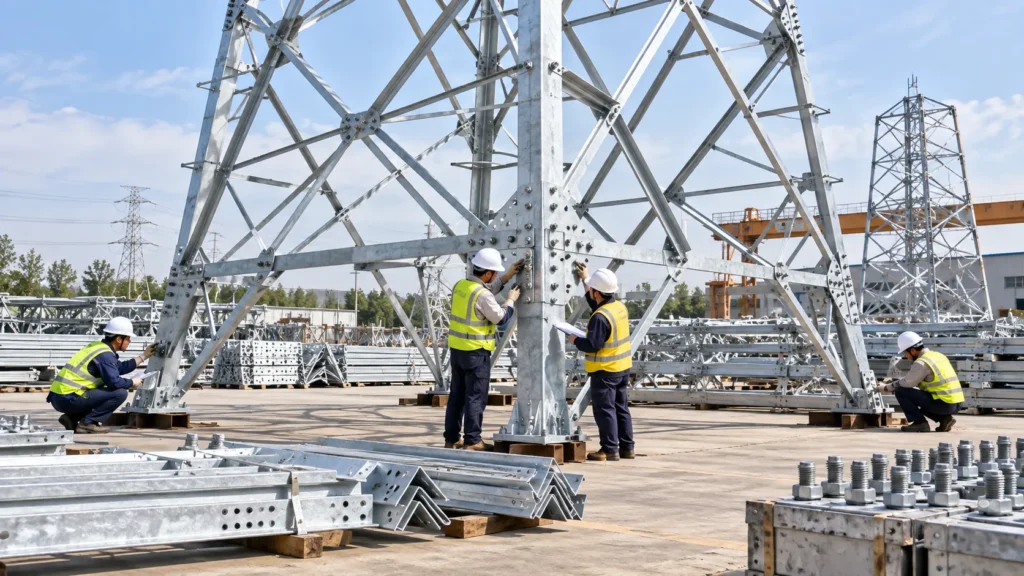
Tower trial assembly verifies that fabricated members can actually be assembled according to the approved drawings before mass production proceeds. It can expose mismatched hole patterns, incorrect member lengths, connection interference, orientation errors, marking problems, and other fabrication issues that may not be obvious when individual components are inspected separately.
The required scope depends on the project specification, tower design, customer requirements, and applicable standards. For new or modified tower designs, a controlled prototype or trial assembly can provide valuable evidence that drawings, fabrication data, physical members, and erection logic agree before the same details are repeated across the production quantity.
What Is Tower Trial Assembly?
Tower trial assembly, sometimes called prototype assembly, proto assembly, or pre-assembly, is the controlled assembly of representative tower components before full-scale repetitive manufacturing proceeds.
Depending on the project specification, this may involve:
- a complete tower;
- a tower body or major section;
- selected panels;
- crossarms;
- body or leg extensions;
- critical connection areas; or
- another defined representative configuration.
The objective is not simply to demonstrate that pieces can be bolted together.
The real purpose is to verify the chain between approved engineering documents, fabrication drawings, member identification, manufactured geometry, connections, and practical assembly.
The required method should always be defined by the governing project specification. Some owners may require physical prototype assembly and witnessing, while others may permit alternative verification methods.
For example, POWERGRID’s transmission-line specification requires proto assembly before mass fabrication in specified circumstances for tower types and extensions that have not previously been proto-assembled or supplied for earlier POWERGRID projects. It also permits software/3D-model-based proto assembly as an alternative under that specification.
Why Check Assembly Before Repeating the Same Detail Hundreds of Times?
Mass production multiplies both correct details and incorrect ones.
Consider a tower design containing a connection where one hole pattern has been transferred incorrectly from an approved drawing into fabrication data.
Producing five affected members creates a manageable correction.
Producing 2,000 affected members creates a production, inspection, galvanizing, packing, shipping, and site problem.
Trial assembly therefore works as an error-amplification barrier. The objective is to find repeatable problems while the affected quantity is still small.
This is particularly valuable when a project involves a new tower type, revised drawings, unfamiliar connection details, multiple extensions, project-specific accessories, or newly prepared shop drawings.
Trial Assembly Verifies More Than Overall Tower Geometry
A useful trial assembly should not end with the statement, “The tower stands up.”
Inspectors should examine how the components actually fit together.
1. Member Dimensions and Geometry
Representative members should correspond with approved fabrication information.
Checks may include:
- member length;
- hole location and spacing;
- edge distances;
- connection geometry;
- orientation;
- bends or formed details;
- plate position; and
- interface dimensions.
The exact tolerances must come from the governing drawing, specification, or applicable standard rather than from a generic rule.
2. Hole Alignment
Hole alignment is one of the most practical reasons to perform trial assembly.
Bolted lattice towers contain many interfaces between angles, plates, bracing members, and connection components. A dimensional error at one interface may propagate into another panel.
The assembly should therefore reveal whether bolts can be inserted in the intended configuration without forcing components into position.
POWERGRID’s specification, for example, states that tower structures should be accurately fabricated so they connect together easily at site without undue strain on the bolts.
That is an important distinction.
The question is not:
Can workers somehow make the members fit?
It is:
Do correctly identified members fit in the intended geometry within the project’s acceptance requirements?
3. Connection Accessibility
A connection can be dimensionally correct but awkward or impossible to tighten.
Trial assembly can reveal interference involving:
- bolt heads;
- nuts;
- adjacent angles;
- gusset plates;
- overlapping members;
- tools required for tightening; and
- nearby connection components.
A drawing review may identify many of these issues, but physical fit-up provides another opportunity to detect them before repetition.
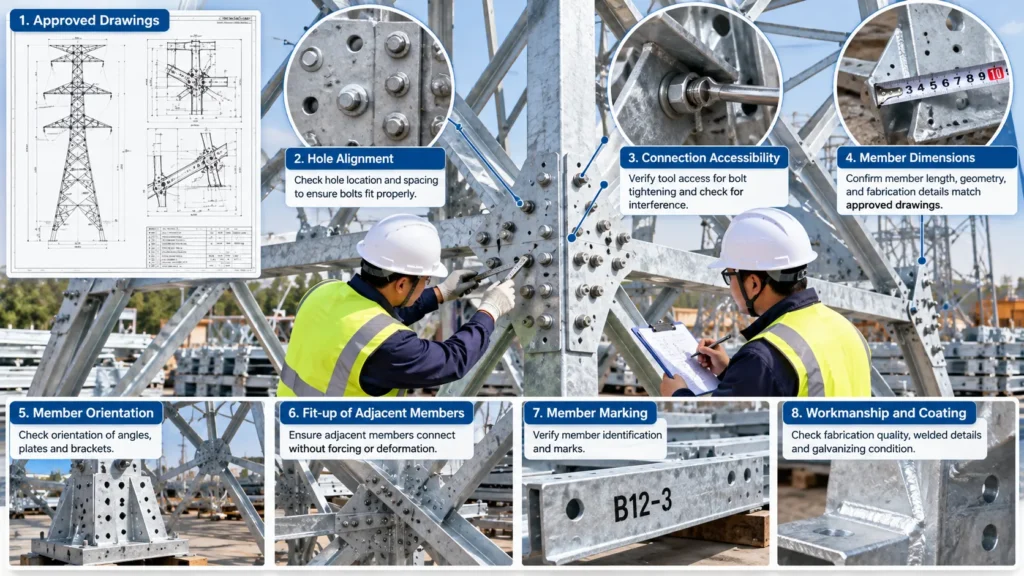
Trial Assembly Connects Drawings With Real Fabrication
Transmission tower manufacturing relies on several connected information sources.
Depending on the project, these may include structural drawings, erection drawings, shop drawings, bills of materials, member schedules, connection details, and fabrication instructions.
A revision that reaches one document but not another creates risk.
For example:
Approved drawing → shop detail → member mark → fabricated part → packing list → erection position
If one link is wrong, the physical trial assembly may expose the inconsistency.
This is why the process should not be treated only as a workshop operation. Findings need to return to document control.
POWERGRID’s specification illustrates this approach: where proto-assembly corrections produce revisions, the contractor is required to incorporate those revisions into the relevant drawings/documents and submit revised documentation for approval.
For procurement teams, this is an important audit question:
If trial assembly finds a problem, how does the supplier prevent the old detail from entering mass production?
A verbal instruction on the factory floor is not enough.
What Problems Can Trial Assembly Find?
The exact findings vary by tower design, but a controlled assembly can help reveal problems such as:
| Potential Issue | How It May Appear During Assembly | Production Risk |
| Incorrect hole location | Bolts do not align naturally | Rework or replacement |
| Wrong member length | Panel geometry cannot be achieved | Assembly distortion |
| Incorrect member orientation | Connection faces the wrong direction | Site installation difficulty |
| Connection interference | Nut, bolt, or tool access is obstructed | Difficult or incomplete tightening |
| Wrong fabrication detail | Physical member differs from approved detail | Repeated nonconformity |
| Member-mark error | Correct part cannot be identified reliably | Wrong erection or missing-part claims |
| BOM inconsistency | Physical components do not match documented requirement | Shortage or excess material |
| Interface conflict | Adjacent assemblies cannot connect as intended | Site modification risk |
These are examples, not universal acceptance criteria. The actual inspection plan should follow the approved project documents.
Trial Assembly Is Not the Same as Tower Load Testing
Buyers should keep trial assembly and full-scale structural testing separate.
Trial assembly primarily checks fabrication compatibility, geometry, connections, identification, and practical assembly.
Full-scale structural testing evaluates structural behavior under specified test loading and acceptance procedures.
ASCE/SEI 10-15, for example, addresses design, fabrication, testing, members, connections, and QA/QC for latticed steel electrical transmission structures. The applicable project documents should determine which testing and verification activities are required for a particular tower.
A tower that fits together correctly has not automatically demonstrated structural load-test compliance.
Likewise, structural calculations do not automatically prove that every fabricated member will fit correctly at site.
The controls answer different questions.
When Is Trial Assembly Especially Valuable?
Trial assembly deserves particular attention when the project introduces something that has not yet been verified through repetitive production.
Examples include a new tower type, changed geometry, revised connection details, new extensions, customer-specific attachments, newly generated shop drawings, or a fabrication change affecting interfaces.
It may also be specified directly by the owner or EPC.
The procurement team should therefore avoid a universal rule such as “every tower must always be fully assembled.”
Instead, establish the requirement before production:
Which tower types require assembly? Which portions must be assembled? Who witnesses it? What measurements are required? What are the acceptance criteria? What records must be submitted?
Those questions turn trial assembly into a controlled inspection activity rather than an informal factory demonstration.
What Should Buyers Witness During Tower Trial Assembly?
Before witnessing begins, the supplier and buyer should agree on the document revision being inspected.
The inspection can then trace physical components back to that controlled document set.
Typical verification points may include:
- tower type and extension being assembled;
- drawing and BOM revision;
- member marks;
- major dimensions;
- hole alignment;
- connection configuration;
- bolts, nuts, and washers where relevant;
- member orientation;
- plate and cleat positions;
- accessibility of connections;
- visible fabrication workmanship;
- specified tower accessories or interfaces;
- nonconformities found;
- corrective actions.
Photographs should be tied to identifiable tower sections or connection locations wherever practical.
Simply receiving several general photographs of an assembled tower provides much weaker evidence than a structured inspection record.

Do Not Let Workers “Force” a Bad Fit Into Acceptance
One of the most important observations during trial assembly is how the structure reaches its final position.
Excessive forcing can hide fabrication problems.
If holes only align after substantial leverage, members require abnormal deformation, or bolts are being used to pull incompatible parts into position, the inspector should investigate the underlying cause rather than treating successful bolt insertion as automatic acceptance.
Possible causes could include incorrect fabrication dimensions, member orientation, drawing discrepancies, accumulated tolerances, or assembly procedure.
The governing specification should determine the acceptable tolerances and corrective action.
This matters because site crews may have much less flexibility than factory workers. They may be working at height, under erection schedules, with limited equipment and replacement material far away.
Corrections Must Reach Mass Production
Finding a problem during prototype assembly is useful.
Finding it and then manufacturing the same error again is not.
A disciplined closeout process should connect each relevant finding to its disposition. Depending on the issue, that may involve:
- recording the nonconformity;
- identifying its cause;
- determining whether the drawing, fabrication data, member, or procedure requires correction;
- obtaining required engineering or customer approval;
- updating controlled documents;
- verifying the corrected assembly where required; and
- releasing the correct revision to production.
The production team should know exactly which revision is authorized.
This document-control step is one of the strongest reasons to perform trial assembly before, rather than during, mass production.
Trial Assembly Can Reduce Overseas Erection Risk
For export projects, fabrication errors become harder to correct after shipment.
A replacement member may require identification, engineering confirmation, fabrication, coating, repacking, international transport, customs handling, and delivery to a remote site.
The direct value of the replacement steel may be small compared with the disruption created by the missing or incompatible component.
Trial assembly cannot eliminate every site problem. Foundation tolerances, handling damage, missing packages, incorrect erection procedures, and site conditions remain separate risks.
But it can reduce one important category: repeatable fit-up problems already present before shipment.
That makes trial assembly relevant not only to QC personnel but also to EPC construction teams and procurement managers responsible for schedule risk.
Documents Buyers Should Request
Where trial assembly is part of the project requirements, the required records should be agreed before manufacturing starts.
Depending on the specification, the documentation package may include:
- approved drawings used for assembly;
- applicable BOM or member schedule;
- inspection and test plan reference;
- trial-assembly inspection report;
- dimensional records;
- nonconformity reports, if applicable;
- photographs of key connections;
- correction records;
- revised drawings;
- approval or release records;
- evidence linking the approved configuration to mass-production documents.
POWERGRID provides a useful real-world example of this traceability principle: its specification refers to proto-inspection reports and supply records as documentary evidence for previously assembled or supplied tower types.
A Practical Pre-Production Release Checklist
Before releasing a tower design for repetitive fabrication, the buyer or manufacturer’s QC team should be able to answer:
- Is the correct drawing revision being used?
- Does the BOM agree with the approved configuration?
- Are representative fabricated members correctly identified?
- Do critical hole patterns and connections align?
- Can the structure be assembled without abnormal forcing?
- Are connection interfaces accessible?
- Have specified accessories and interfaces been checked?
- Have trial-assembly findings been documented?
- Have required corrections been incorporated into controlled documents?
- Has the applicable inspection or approval authority accepted the result where required?
- Is production using the final released revision?
If any answer is unclear, the risk has probably not been fully closed.
Where HSD Steelwork Fits Into the Process
Qingdao Hengshengda Steel Structure Co., Ltd. manufactures transmission towers, substation structures, steel tubular poles, and hot-dip galvanized steel components. Project drawings and technical specifications can be reviewed when preparing a manufacturing proposal.
For a tower project where trial assembly or prototype inspection is required, the RFQ should identify that requirement clearly rather than leaving it until production has started.
The required scope, tower types, witness points, inspection criteria, documentation, and approval process should be defined by the project specification and agreed before manufacturing.
What to Include in Your Tower RFQ
To evaluate manufacturing and inspection requirements efficiently, provide as much controlled project information as possible:
- project location;
- applicable standards and technical specification;
- tower types and extensions;
- structural and/or fabrication drawings;
- BOM where available;
- steel grades;
- bolt requirements;
- galvanizing or coating specification;
- quantity by tower type;
- prototype or trial-assembly requirements;
- inspection and witness requirements;
- packing requirements;
- destination;
- required project schedule.
Send your tower drawings, specifications, quantities, inspection requirements, and delivery destination to HSD Steelwork for manufacturing review.
FAQ
Is trial assembly required for every transmission tower project?
Not necessarily. Requirements depend on the owner, EPC specification, applicable standards, tower design, previous qualification evidence, and contractual inspection plan. Buyers should define the requirement before fabrication.
What is the difference between trial assembly and prototype testing?
Trial assembly mainly verifies physical fit-up, geometry, interfaces, identification, and fabrication compatibility. Prototype or full-scale structural testing may involve applying specified loads to evaluate structural performance. They should not be treated as equivalent.
Does the entire tower have to be assembled?
Not always. The required scope may be a complete tower, major sections, panels, extensions, crossarms, or selected critical interfaces. The project specification should define the scope.
What happens if a problem is found during trial assembly?
The issue should be recorded, evaluated, corrected, and reflected in the relevant controlled documents or manufacturing data where necessary. Required approvals should be completed before affected details enter mass production.
Can 3D modeling replace physical trial assembly?
Only where the governing project specification or customer permits it. POWERGRID’s cited specification, for example, allows suitable software/3D modeling as an alternative to physical proto assembly in the circumstances described by that specification. This should not be generalized to other projects.
Why does trial assembly matter more for export projects?
Because correcting a repeatable fabrication problem after international shipment can involve replacement production, coating, logistics, customs, and site delays. Pre-production verification can identify some of these fit-up risks while correction is still comparatively manageable.