


Choosing between a lattice tower and a steel monopole is not simply a question of which structure is stronger or cheaper. The decision affects right-of-way requirements, foundation design, transportation, erection methods, inspection access, visual impact, and ultimately the installed cost of a transmission-line structure.
For utilities and EPC contractors, the more useful question is: Which structure fits the electrical configuration, loading conditions, site constraints, construction method, and project economics?
Quick Answer
Neither a lattice tower nor a steel monopole is universally better. Lattice towers are widely used where larger structural footprints are acceptable and where modular members, field bolting, and flexible tower configurations suit the project. Steel monopoles use a compact tubular shaft and can reduce the physical footprint of the support, making them attractive where right-of-way or visual constraints are important. However, the final choice must account for structural loads, conductor arrangement, foundation requirements, transportation limits, erection equipment, corrosion protection, maintenance strategy, and total installed cost.
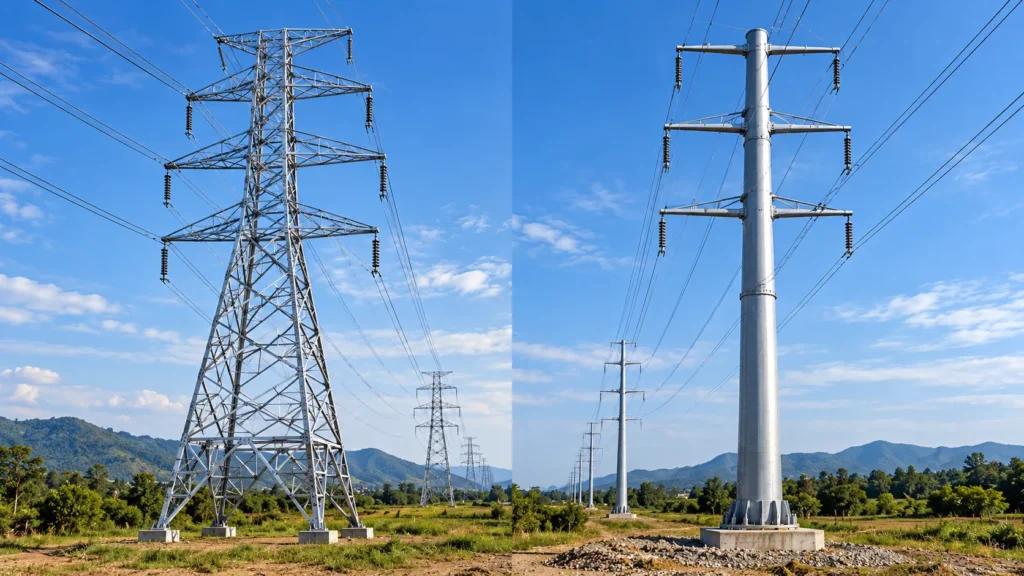
What Is the Structural Difference?
A lattice transmission tower is assembled from many individual steel members connected to form a three-dimensional truss.
Typical members may include:
- main legs;
- bracing members;
- crossarms;
- redundant members;
- gusset plates;
- bolts and other connection hardware.
The open framework distributes loads through multiple interconnected members.
A steel monopole takes a different approach. It normally consists of one or more tapered tubular steel shaft sections. Depending on the design, sections may use slip joints, flanged connections, or another engineered connection system. Crossarms and conductor attachment components are connected to the main shaft.
This difference in structural form influences almost every subsequent procurement and construction decision.
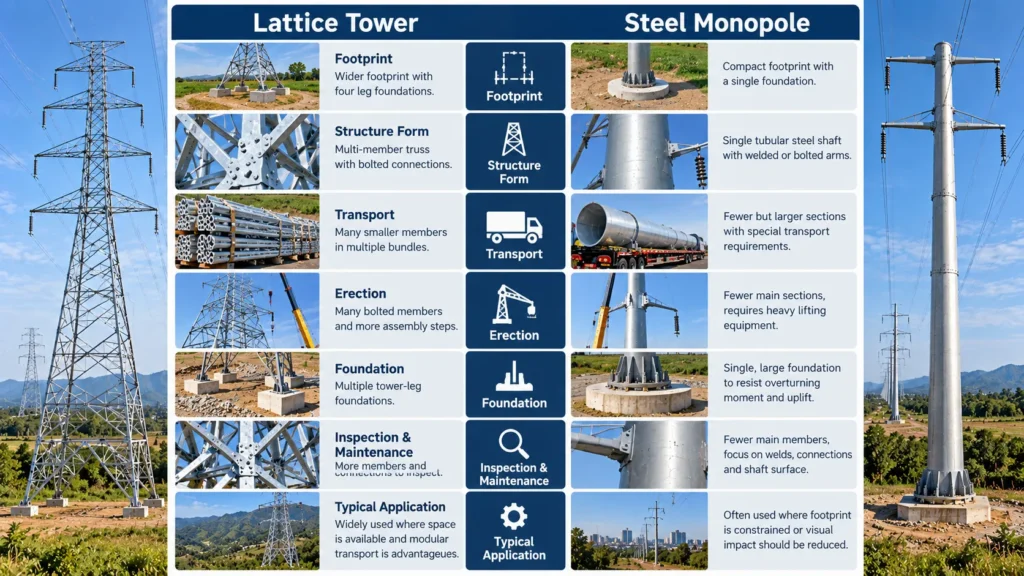
Lattice Tower vs Steel Monopole at a Glance
| Factor | Lattice Tower | Steel Monopole |
| Main structure | Multi-member truss | Tubular steel shaft |
| Ground footprint | Generally wider | Generally more compact |
| Member count | High | Lower |
| Transport units | Many relatively small members | Fewer but much larger sections |
| Field assembly | Significant bolted assembly | Fewer major structural sections |
| Heavy lifting | Depends on erection method | Often important for large pole sections |
| Visual profile | More complex/open | Simpler, cleaner profile |
| Inspection | Many members and connections | Fewer main members, but welds and pole connections require attention |
| Typical site advantage | Space available, modular transport useful | Restricted sites or narrow structural footprint |
| Foundation concept | Often multiple tower-leg reactions | Concentrated pole-base reaction |
These are general characteristics rather than design rules. Structure geometry and construction methods vary substantially by voltage, loading, line configuration, local standards, and project specifications.
Footprint and Right-of-Way Can Change the Decision
One of the clearest differences is the space occupied at the structure location.
A self-supporting lattice tower typically spreads its legs over a larger base area. This geometry can be efficient structurally, but it requires sufficient ground space and suitable foundation locations.
A monopole concentrates the structure around one shaft. Its physical footprint can therefore be considerably smaller.
This can be valuable where structures must be installed near:
- urban roads;
- industrial facilities;
- existing infrastructure;
- constrained substations;
- narrow corridors;
- locations where usable land around the structure is limited.
A smaller tower footprint, however, should not be confused with automatically simpler foundations.
Compare Foundations, Not Just the Visible Steel
The structure above ground is only part of the selection problem.
A lattice tower distributes structural actions through multiple legs. Depending on the design and geotechnical conditions, each leg may have its own foundation.
A monopole transfers loads through a concentrated base. Its foundation may therefore need to resist substantial overturning moment, shear, compression, and uplift effects.
As a result, comparing only the weight or price of the steel structure can give procurement teams an incomplete picture.
A better commercial comparison includes:
structure + foundation + transport + erection + access + maintenance.
Geotechnical conditions can materially change the result. Weak soils, rock excavation, high groundwater, difficult access, or foundation construction restrictions should therefore be evaluated before the structure type is finalized.
Which Is Easier to Transport?
The answer depends heavily on the route to site.
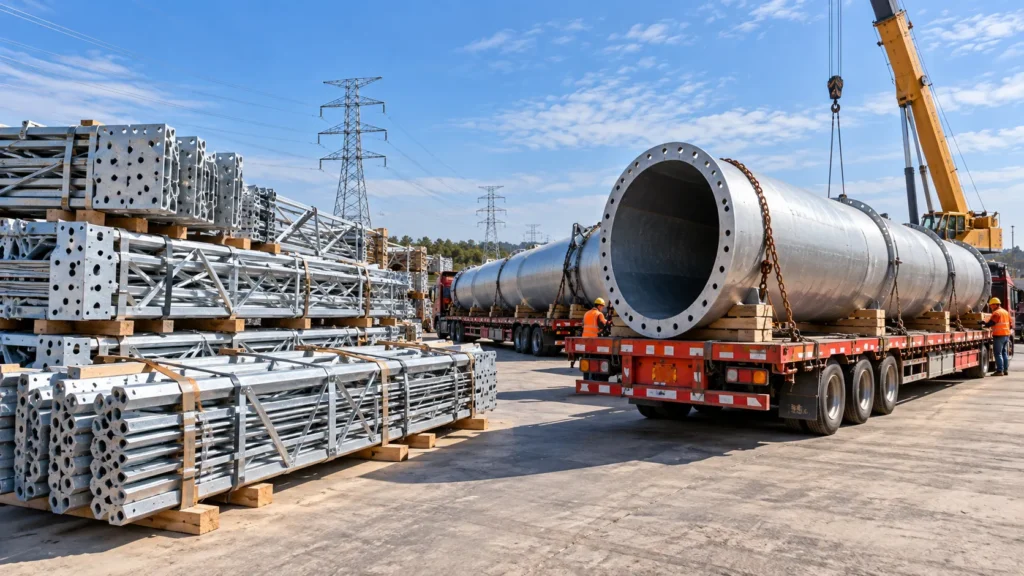
Lattice towers have a logistical advantage in projects where large components are difficult to transport. Individual angles, plates, and other members can be bundled into comparatively manageable packages.
That can help on remote projects with:
- narrow roads;
- restricted bridge capacities;
- difficult mountain access;
- limited turning radius;
- constrained unloading areas.
The trade-off is quantity. A lattice tower can contain a large number of individual pieces, so marking, packing, reconciliation, and erection control become important.
Monopoles involve fewer principal structural pieces, but shaft sections can be long, heavy, and large in diameter.
Before selecting monopoles, the project team should verify trailer limits, route clearances, turning requirements, unloading equipment, crane capacity, and site access.
Which Is Faster to Erect?
It depends on how the contractor plans to build the line.
Lattice structures require the assembly of many members and bolted connections. They may be assembled in sections on the ground, erected progressively, or installed using other project-specific methods.
This creates more individual assembly operations.
A monopole has fewer main structural pieces. With suitable access and lifting equipment, large pole sections can potentially simplify the main structural erection sequence.
But fewer pieces do not automatically mean easier installation.
A project with poor crane access, difficult terrain, restricted working space, or very large pole sections may face significant erection constraints.
The correct question is therefore not simply, “Which has fewer parts?”
It is:
Which structure matches the contractor’s available access, equipment, lifting plan, workforce, and erection sequence?
Which Structure Is Better for Inspection and Maintenance?
The inspection workload is different rather than absent.
A lattice tower contains many members, bolts, connection plates, edges, drainage points, and galvanized surfaces. Inspection therefore requires systematic coverage.
Typical checks may include:
- missing or loose fasteners;
- damaged or deformed members;
- coating deterioration;
- corrosion at connections;
- damaged galvanizing;
- member identification;
- climbing and safety components where specified.
Monopoles have fewer main structural members, but inspection must still address critical welds, connections, shaft surfaces, base details, drainage, access openings, and corrosion-protection condition.
The procurement specification should define inspection and maintenance access rather than assuming that one structural type will automatically require less lifecycle attention.
Does a Monopole Always Look Better?
Visual impact is one reason monopoles are considered for some projects.
Their single-shaft profile is visually simpler than the broader geometry of a lattice tower. A U.S. Department of Energy project document, for example, described monopoles as having a smaller footprint and being less visually obtrusive than conventional lattice designs for the project being evaluated.
That should be treated as a project-planning consideration, not a universal engineering rule.
Structure height, conductor configuration, crossarm geometry, background landscape, spacing, and local permitting requirements all influence visual impact.
Which Is Cheaper: Lattice Tower or Monopole?
There is no reliable universal percentage difference.
A useful cost comparison should separate at least:
- structural steel and fabrication;
- corrosion protection;
- fasteners and accessories;
- foundation construction;
- inland transportation;
- export packing and ocean freight where applicable;
- unloading and storage;
- site assembly;
- cranes and erection equipment;
- inspection and maintenance requirements.
A monopole may reduce the number of structural pieces but require larger formed plate sections, substantial welding, specialized fabrication, heavy transport, and significant foundation works.
A lattice tower may use more individual members and connections but can offer modular transportation and erection options.
For that reason, installed project cost is more useful than comparing steel tonnage or ex-works price alone.
Structural Loading Must Come Before Tower Preference
Neither tower type should be selected solely from appearance or initial price.
The engineer must first establish the applicable loading and reliability criteria.
IEC 60826:2017 provides reliability-based loading and strength requirements for overhead transmission lines and applies primarily to lines of 45 kV and above, while allowing its principles to be used at lower voltages. The standard also notes that detailed design of supports and foundations is outside its scope.
In projects using ASCE references, different standards address the two structural forms. ASCE/SEI 10 covers latticed steel electrical transmission structures, while ASCE/SEI 48 addresses steel transmission pole structures.
Project engineers must still apply the specified edition, national requirements, utility specifications, climatic data, loading cases, and project-specific criteria.
When Does a Lattice Tower Make Sense?
A lattice tower may deserve consideration when:
- adequate structure footprint is available;
- modular transportation is valuable;
- large pole sections would be difficult to deliver;
- the line configuration suits a lattice arrangement;
- the contractor has established lattice-tower erection methods;
- the project specification or utility standard already uses lattice structures.
This does not mean every rural or high-voltage line should use lattice towers. The electrical and structural design still controls the decision.
When Does a Steel Monopole Make Sense?
A steel monopole may deserve consideration when:
- the structure footprint must be compact;
- the corridor is physically constrained;
- visual simplicity is a project consideration;
- suitable transport routes are available for large pole sections;
- crane access supports the erection method;
- the electrical configuration can be accommodated by the pole and crossarm arrangement.
Again, these are screening criteria rather than a substitute for engineering analysis.
Procurement Risks to Check Before Selecting Either Structure
Changing structure type late in a project can affect more than the tower drawing.
Procurement teams should verify whether the proposed change affects:
Electrical clearances.
Conductor positions, phase spacing, insulator geometry, shielding, and clearances must remain compliant with the project design.
Foundations.
Changing from a four-leg lattice structure to a monopole changes how loads enter the foundation system.
Transportation.
A design that can be fabricated may still be impractical to deliver to the site.
Erection equipment.
Crane requirements and working areas should be established before shipment.
Corrosion protection.
The coating specification and inspection criteria should be agreed before fabrication.
Interfaces.
Crossarms, insulator attachments, climbing systems, grounding provisions, signage, anti-climbing devices, and other accessories should be defined in the approved drawings.
Documents Buyers Should Request
For either structural type, the required documentation should be agreed before production.
Depending on the contract, this may include:
- approved drawings;
- bill of materials;
- material certificates;
- welding documentation where applicable;
- dimensional inspection records;
- galvanizing or coating inspection records;
- bolt and fastener documentation;
- identification and packing lists;
- inspection and test records required by the project;
- structure test documentation where specified.
The document list should follow the contract, applicable standard, inspection and test plan, and utility requirements.
Information Needed for a Meaningful Supplier Comparison
Do not send suppliers only a voltage level and quantity.
For a technically useful comparison, provide as much of the following as available:
- project location;
- line voltage;
- applicable design standard and edition;
- utility specification;
- structure function;
- suspension, tension, angle, dead-end, or other structure classification;
- conductor and ground-wire configuration;
- design loads or approved loading criteria;
- tower or pole geometry;
- required electrical clearances;
- steel grade requirements;
- corrosion-protection specification;
- geotechnical or foundation interface requirements;
- quantities;
- inspection requirements;
- packing requirements;
- destination;
- required delivery schedule.
This information allows the comparison to move from a generic “lattice versus monopole” discussion to an actual project-specific engineering and procurement decision.
How HSD Steelwork Fits Into the Evaluation
For an HSD Steelwork inquiry involving lattice towers or steel monopoles, the RFQ should include the applicable drawings, loading requirements, material specification, coating requirements, quantities, inspection requirements, packing requirements, and delivery destination.
Product range, dimensional limits, applicable manufacturing processes, testing capability, certifications, production capacity, and delivery commitments should be confirmed against current HSD documentation before they are stated as project capabilities.
Conclusion
The lattice tower vs steel monopole decision is a trade-off between structural requirements and project constraints.
A lattice tower can be attractive where space is available, modular transport is useful, and established lattice construction methods suit the project. A steel monopole can be attractive where a compact footprint and simpler visual profile are important and the project can accommodate its transport, foundation, and erection requirements.
The final selection should be made using the complete installed system rather than appearance, steel weight, or unit price alone.
For a supplier comparison or quotation, send the project location, applicable standard, structure drawings, loading criteria, conductor configuration, material and coating requirements, quantities, inspection requirements, destination, and required schedule.
FAQ
Are monopoles stronger than lattice towers?
Strength cannot be determined from the structural type alone. Both can be engineered for specified load cases. Capacity depends on geometry, materials, member or shaft design, connections, foundations, loading criteria, and the applicable design standard.
Do monopoles require less land than lattice towers?
The physical support footprint is generally more compact because a monopole uses a single shaft rather than widely spaced tower legs. The complete project right-of-way, however, also depends on conductor geometry, electrical clearances, safety requirements, and local regulations.
Are lattice towers cheaper than monopoles?
Not necessarily. Cost varies with steel quantity, fabrication, foundations, freight, access, erection equipment, labor, inspection, and project location. Compare installed cost rather than using a universal cost ratio.
Which is better for urban transmission lines?
A monopole is often considered where the support footprint or visual profile is constrained, but urban selection also depends on loading, clearances, foundations, transport access, permitting, construction space, and lifecycle requirements.
Which tower is easier to transport to remote sites?
Lattice towers can offer logistical advantages because they are divided into many smaller members. Large monopole sections may require specialized trailers and route clearance. Actual logistics should be checked against the proposed structure dimensions and site route.
Can a lattice tower be replaced directly with a monopole?
Not without engineering review. Changing the structure type can alter foundation reactions, conductor geometry, structural behavior, clearances, erection requirements, and interfaces. The revised system should be checked against the governing project criteria.