


A supplier quotes 10,000 galvanized bolts at an attractive price. After reviewing the offer, the buyer discovers that nuts and washers are excluded, the thread pitch was never specified, and the coating requirement is unclear.
The quotation may be inexpensive, but it is not ready for purchase.
For industrial fastener buyers, EPC contractors, and distributors, incomplete specifications can lead to incompatible components, additional costs, delayed deliveries, and installation problems.
A well-prepared request for quotation (RFQ) helps suppliers understand exactly what to provide. It also makes competing offers easier to evaluate.
This guide explains the information required when purchasing bolts, nuts, and washers as standalone industrial fastener orders, including dimensions, threads, mechanical grades, standards, coatings, quantities, inspection requirements, and delivery conditions.
It also includes a downloadable Excel RFQ template that buyers can complete and submit to HSD Steelwork.
Quick Answer: What Should a Bolts, Nuts and Washers RFQ Include?
A complete bolts, nuts and washers RFQ checklist should specify the fastener type, nominal diameter, length, thread pitch, dimensional standard, material or mechanical property class, surface coating, quantity, and matching components. Buyers should identify whether bolts, nuts, and washers are purchased separately or as complete sets. For industrial and project orders, the RFQ should also cover inspection requirements, certificates, packing, delivery destination, and requested schedule. Where components must work together, their standards and compatibility should be confirmed before ordering. A structured Excel RFQ template helps buyers organize these requirements and obtain quotations based on a consistent technical scope.
1. What Types of Fasteners Are You Purchasing?
The first step is to identify the product category and intended application.
Industrial fastener orders may include:
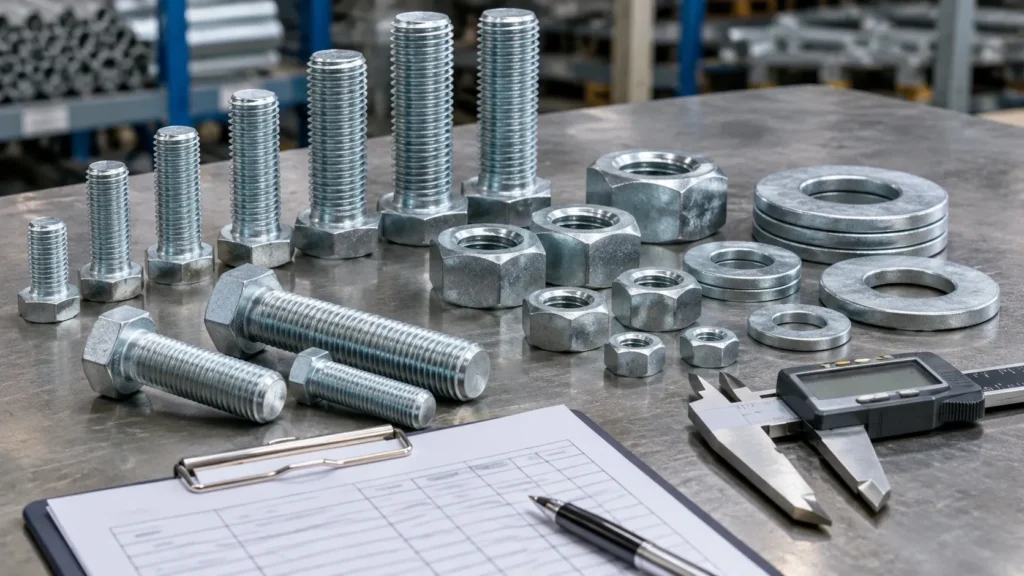
- Hex head bolts and hex cap screws
- Heavy hex structural bolts
- Hex nuts and heavy hex nuts
- Flat washers and hardened washers
- Locking washers or other specified locking devices
- Threaded rods, studs, and anchor bolts
- Custom fasteners manufactured to approved drawings
These products are used in structural steel connections, industrial equipment, machinery, energy infrastructure, transportation facilities, and general construction.
The application affects which standards and mechanical properties are appropriate.
For example, a general-purpose hex bolt and a high-strength structural bolt may have similar nominal dimensions but different product specifications and inspection requirements.
RFQ recommendation: Identify the fastener type and intended application. If the product is for a structural connection, include the governing structural bolting specification.
2. What Bolt Dimensions and Thread Details Must Be Specified?
Bolt dimensions should be defined precisely enough for the supplier to identify the correct product.
Nominal Diameter
Specify the diameter using the applicable metric or inch designation.
Examples include M12, M16, M20, M24, 1/2 inch, and 3/4 inch.
The measurement system must be clear because metric and inch threads are not interchangeable.
Bolt Length
For many conventional hex head bolts, nominal length is measured from beneath the head to the bolt end. Different head styles may follow different conventions.
For example:
M20 × 80 mm
This identifies a nominal metric diameter of 20 mm and a nominal length of 80 mm.
It does not fully define the thread pitch, head dimensions, threaded length, mechanical grade, or coating.
Thread Pitch and Thread System
A complete specification should identify:
- Metric or inch thread system
- Coarse or fine thread
- Thread pitch or threads per inch
- Thread tolerance class where required
- Full or partial threading
- Minimum threaded length, where relevant
For example, M20 × 1.5 identifies a metric fine thread with a 1.5 mm pitch.
If the buyer requires a specific partially threaded bolt, the relevant product standard and thread length requirements should also be stated.
RFQ recommendation: Never rely on diameter and length alone when the required thread configuration is critical.
3. How Should Bolt, Nut, and Washer Grades Be Specified?
Mechanical properties determine whether a fastener is suitable for its intended loading and service conditions.
For applicable metric carbon steel and alloy steel bolts, ISO 898-1 establishes mechanical property requirements. Common property classes include 4.6, 8.8, and 10.9.
A higher property class is not automatically a better choice for every application. Selection must consider the connection design, material compatibility, coating process, installation requirements, and governing specifications.
Specify Each Component Separately
| Component | Information to provide |
| Bolt | Material, property class or grade, product standard |
| Nut | Material, property class or grade, dimensional standard |
| Washer | Material, type, dimensions, hardness where required |
| Complete assembly | Approved combination of components |
A bolt property class alone does not establish the correct nut grade or washer specification.
For structural bolting systems governed by ASTM requirements, specifications such as ASTM F3125/F3125M, ASTM A563/A563M, and ASTM F436/F436M may be relevant. The correct combination must follow the applicable specification.
RFQ recommendation: Request a technically compatible assembly rather than selecting bolt, nut, and washer grades independently without verification.
4. Which Fastener Standards Should Be Included in an RFQ?
A fastener order may require several standards because dimensions, mechanical properties, coatings, and inspection are different technical subjects.
| Standard | Main application |
| ISO 4014 | Hexagon head bolts |
| ISO 4017 | Hexagon head screws |
| ISO 898-1 | Mechanical properties of applicable bolts, screws, and studs |
| ISO 4032 | Hexagon regular nuts |
| ISO 7089 | Plain washers, normal series |
| ISO 10684 | Hot-dip galvanized coatings on applicable fasteners |
| ASTM F3125/F3125M | Specified high-strength structural bolts and assemblies |
| ASTM A563/A563M | Carbon and alloy steel nuts |
| ASTM F436/F436M | Hardened steel washers |
| ASTM F2329/F2329M | Hot-dip zinc coating for specified steel fasteners |
ASTM’s fastener standards directory identifies the applicable product and coating specifications, including structural bolt and hot-dip galvanizing requirements.
Not every standard applies to every fastener.
For example, ISO 898-1 defines mechanical properties within its scope; it does not replace the relevant dimensional product standard.
Similarly, ISO and ASTM fasteners should not be treated as interchangeable simply because they have comparable nominal sizes.
RFQ recommendation: Include the exact standard designation and edition required by the project. Identify any special deviations or additional customer specifications.
5. What Coating Requirements Should Buyers Specify?
The surface finish influences corrosion resistance, thread fit, handling, and cost.
Common options include plain steel, zinc electroplating, hot-dip galvanizing, and other specified protective coating systems.
The appropriate choice depends on the application, exposure environment, mechanical grade, and relevant project standards.
Hot-Dip Galvanized Fasteners
For applicable metric threaded fasteners, ISO 10684:2004 specifies requirements for hot-dip spun galvanized coatings. Its stated scope includes certain coarse-threaded steel fasteners from M8 through M64, subject to defined property class limitations.
Fasteners — Hot dip galvanized coatings
For fasteners purchased under ASTM requirements, ASTM F2329/F2329M may be applicable to hot-dip zinc coating.
Products & Services
Buyers should not assume that general structural steel galvanizing requirements automatically establish all requirements for threaded fasteners.
Why Thread Compatibility Matters
A zinc coating changes the dimensions of threaded surfaces.
Depending on the applicable coating specification, coordinated bolt and nut thread allowances or processing may be necessary to obtain the required fit.
For high-strength fasteners, the coating process must also be compatible with the material and applicable restrictions.
The RFQ should identify the coating standard, required finish, thread compatibility provisions, and any special inspection requirements.
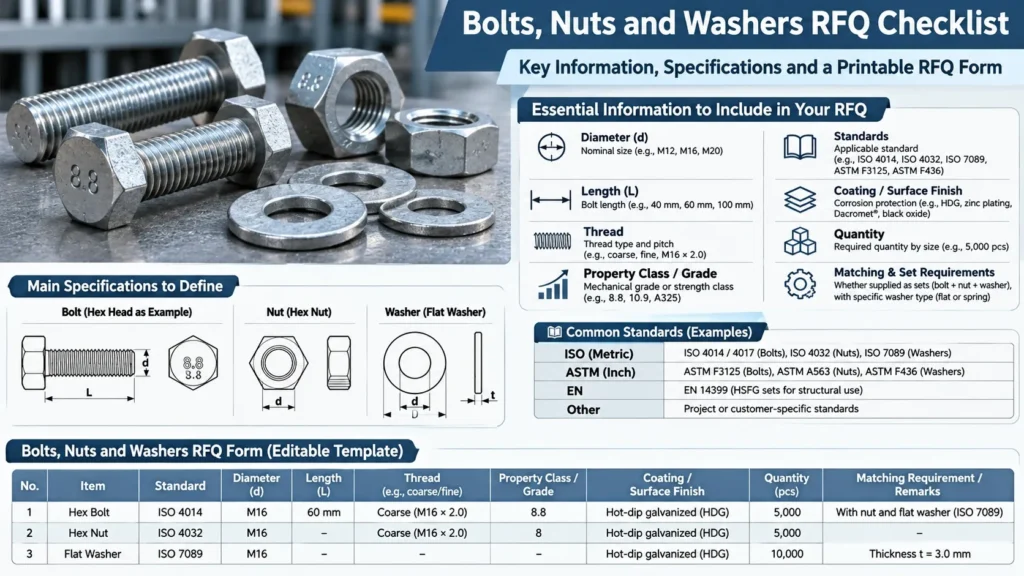
6. How Many Nuts and Washers Should Be Included Per Bolt?
Buyers should specify whether the quotation covers individual components or complete fastener assemblies.
For example, a buyer may require one bolt, one nut, and two flat washers per set.
Illustrative example only; actual component quantities depend on the approved connection design.
| Component | Per set | For 5,000 sets |
| Hex bolt | 1 | 5,000 pcs |
| Hex nut | 1 | 5,000 pcs |
| Flat washer | 2 | 10,000 pcs |
The buyer should clearly state whether the supplier must quote 5,000 complete sets or separate component quantities.
This distinction is especially important when comparing offers from multiple suppliers.
Separate Components or Matched Sets?
For distributors, individually packed bolts, nuts, and washers may be appropriate.
For EPC projects and industrial installations, matched sets or project-specific kits may simplify material receiving and inventory control.
However, packaging components together does not prove their technical compatibility.
RFQ recommendation: Define the components per set, total quantity, spare quantity, and preferred packaging arrangement.
7. What Inspection and Quality Documents Should Be Requested?
Fastener inspection requirements should be established before the purchase order is issued.
Depending on the product and application, buyers may request:
- Material certificates
- Mechanical property test reports
- Dimensional inspection reports
- Thread inspection records
- Coating inspection reports
- Lot identification and traceability records
- Certificates of conformity
- Third-party inspection documentation
Not every order requires all these documents.
For example, an ordinary commercial fastener order may have different documentation requirements from a safety-critical structural connection.
For high-strength structural bolting, the American Institute of Steel Construction identifies specific quality requirements and component specifications that should be considered during purchasing.
Questions to Ask Before Ordering
Confirm whether inspection is performed by lot, what sampling requirements apply, which acceptance criteria govern the results, and what documentation must accompany the shipment.
If third-party inspection is required, specify the inspection scope and witness or hold points before production or shipment.
8. What Packing and Delivery Information Should Be Included?
A technically complete RFQ should also define the commercial delivery scope.
Important details include the requested quantity, destination, packaging method, shipment schedule, and applicable delivery terms.
For international orders, buyers should consider:
- Bulk cartons, boxes, pallets, or matched-set packing
- Maximum package weight where relevant
- Package identification and lot marking
- Protection against moisture and handling damage
- Destination port or delivery address
- Applicable Incoterms rule and named place
- Required shipping and customs documents
For orders containing multiple sizes or grades, clear package labels help prevent receiving and installation errors.
Buyers should also distinguish production lead time from transportation time when comparing supplier schedules.
9. Download the Free Bolts, Nuts and Washers RFQ Template
Preparing a detailed fastener inquiry does not need to involve creating a new spreadsheet from scratch.
Use the HSD Steelwork Fastener RFQ Template to organize product specifications and purchasing requirements before contacting suppliers.
How to Complete the RFQ Template
- Enter your company and project information.
- List each required fastener size or specification as a separate line item.
- Specify bolt, nut, and washer standards and matching requirements.
- Add coating, inspection, certification, and packing requirements.
- Enter quantities, delivery destination, and requested schedule.
- Attach drawings or technical specifications for nonstandard products.
If a specification is not yet confirmed, mark it as To Be Confirmed instead of making an unsupported technical assumption.
The template is suitable for standalone fastener inquiries as well as fastener schedules associated with larger engineering projects.
10. Example of a Completed Fastener RFQ Line Item
The following example demonstrates how to organize a purchasing inquiry.
| RFQ Field | Example Entry |
| Product | Hex head bolt assembly |
| Bolt Size | M20 × 80 mm |
| Thread | Metric coarse |
| Bolt Standard | ISO 4014 |
| Bolt Property Class | 8.8 |
| Nut | Matching hex nut; grade and standard to be confirmed |
| Washer | Two flat washers; specification to be confirmed |
| Surface Finish | Hot-dip galvanized |
| Coating Standard | ISO 10684, subject to applicability |
| Quantity | 5,000 sets |
| Inspection | Requirements to be confirmed |
| Destination | Buyer to specify |
This is an illustrative RFQ entry, not a validated connection design or approved fastener assembly.
The nut, washer, coating, and assembly requirements must be finalized against the applicable engineering specifications before ordering.
11. Common Fastener RFQ Mistakes and How to Avoid Them
Mistake 1: Requesting only a bolt diameter.
Without length, thread, grade, and product standard information, suppliers may quote different products.
Mistake 2: Specifying “galvanized” without a coating standard.
Different coating processes have different requirements and may affect thread fit.
Mistake 3: Assuming nuts and washers are included.
A supplier may quote bolts only unless the RFQ explicitly requests complete sets.
Mistake 4: Mixing incompatible grades or standards.
The correct fastener assembly must meet the governing specification, not simply have matching nominal diameters.
Mistake 5: Requesting certificates after the order is placed.
Additional testing or documentation can affect price, availability, and delivery planning.
Mistake 6: Omitting destination and packing details.
An ex-works quotation and a delivered quotation may cover very different commercial scopes.
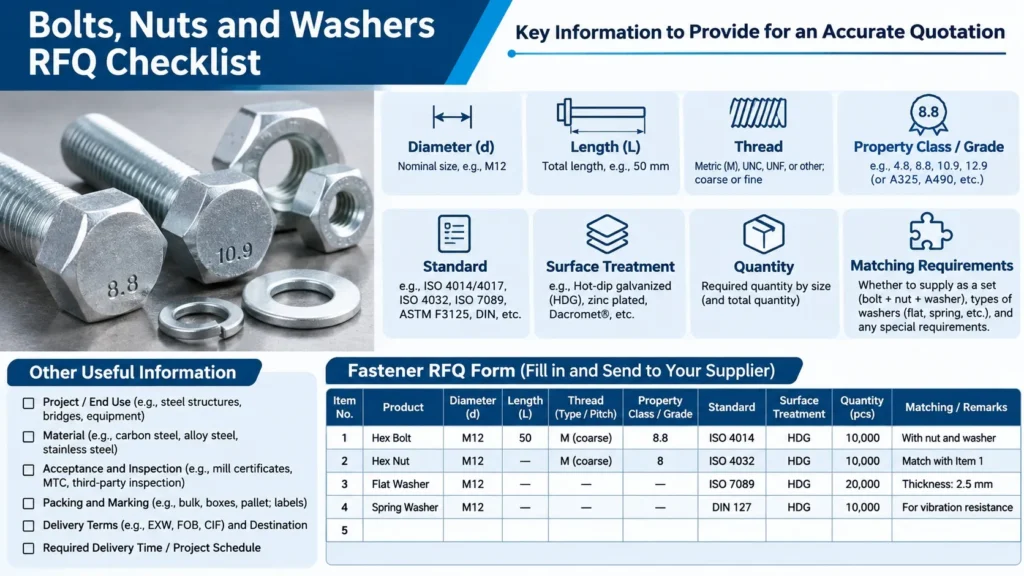
12. Fastener RFQ Checklist Before Submission
Before sending your inquiry, verify that the following information has been included.
Fastener RFQ Readiness
0 of 9 checkedReady to Request a Fastener Quotation?
Download our editable Excel RFQ template to organize your fastener specifications, quantities, coating requirements, and delivery details. Then submit your completed file and drawings to HSD Steelwork.
Step 1: Download and complete the Excel template.
Step 2: Upload the file through our contact form.
A complete checklist helps suppliers identify technical gaps early and reduces the need for repeated clarification during quotation.
13. Request a Bolts, Nuts and Washers Quotation from HSD Steelwork
HSD Steelwork provides a purchasing inquiry route for bolts, nuts, washers, and related industrial fastening hardware.
Buyers can submit standalone fastener requirements or component lists associated with larger industrial and infrastructure projects.
For product information, see the HSD Steelwork bolts and hardware page.
To request a quotation, prepare your completed RFQ template and any relevant technical drawings.
Frequently Asked Questions
1. Can I purchase bolts, nuts, and washers separately?
Yes. Fasteners can be specified as individual products or complete assemblies. Clearly identify the quantities and components required for each line item.
2. Can I submit several bolt sizes in one RFQ?
Yes. Use a separate line item for each unique combination of size, thread, grade, coating, and accessories. This helps suppliers prepare itemized quotations.
3. Are galvanized bolts compatible with standard nuts?
Not necessarily. Hot-dip galvanized threaded fasteners may require coordinated thread allowances or nut processing. Compatibility must be confirmed against the applicable standard.
4. What is the difference between property classes 8.8 and 10.9?
They represent different mechanical property requirements for applicable metric fasteners. The appropriate class must be selected according to the connection design and governing specification.
5. Can ISO fasteners replace ASTM fasteners?
Not automatically. The two systems may have different dimensional, mechanical, thread, and assembly requirements. Any substitution requires technical approval.
6. Are material certificates required for every fastener order?
Not always. Documentation requirements depend on the product, application, purchase specification, and contract. Buyers should identify mandatory certificates in the RFQ.
7. Can I send an incomplete RFQ for preliminary review?
Yes. Clearly identify missing specifications and attach any available drawings or project documents. Final product selection and quotation may require additional clarification.