


A steel fabrication quotation can look competitive until production begins and the supplier discovers that the drawings do not define the mounting-hole tolerances, the bill of materials does not match the latest revision, or the inspection requirements were never included in the original price.
For equipment manufacturers and EPC contractors, these gaps create more than administrative work. They can lead to engineering clarification cycles, fabrication rework, unexpected inspection charges, and installation delays.
A well-prepared steel fabrication RFQ helps suppliers price the same scope and identify technical risks before a purchase order is issued.
Quick Answer: What Should a Steel Fabrication RFQ Include?
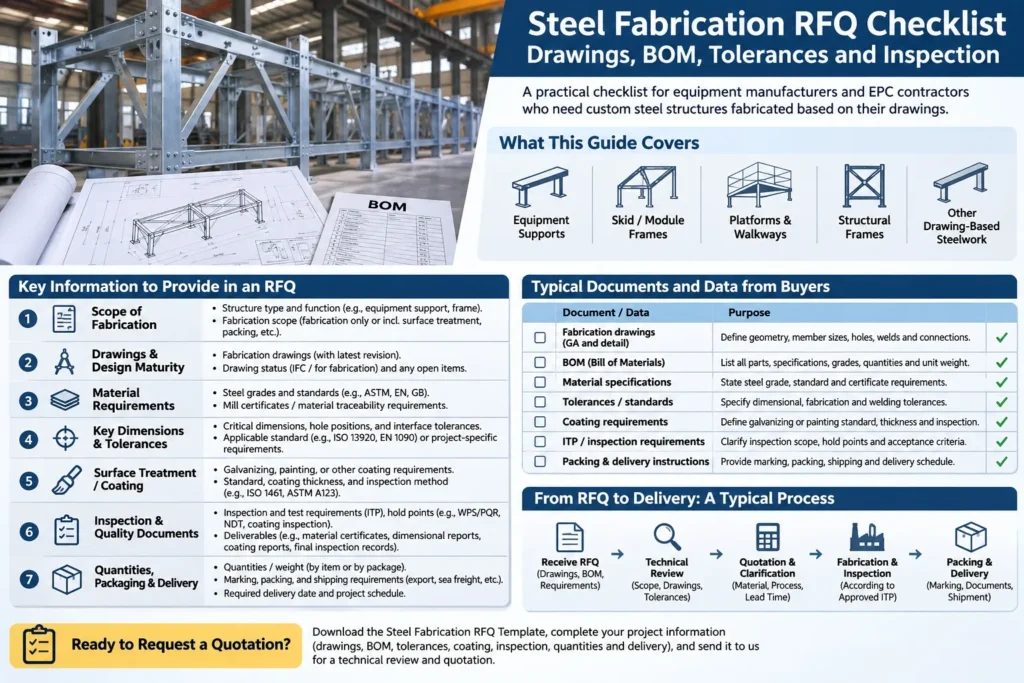
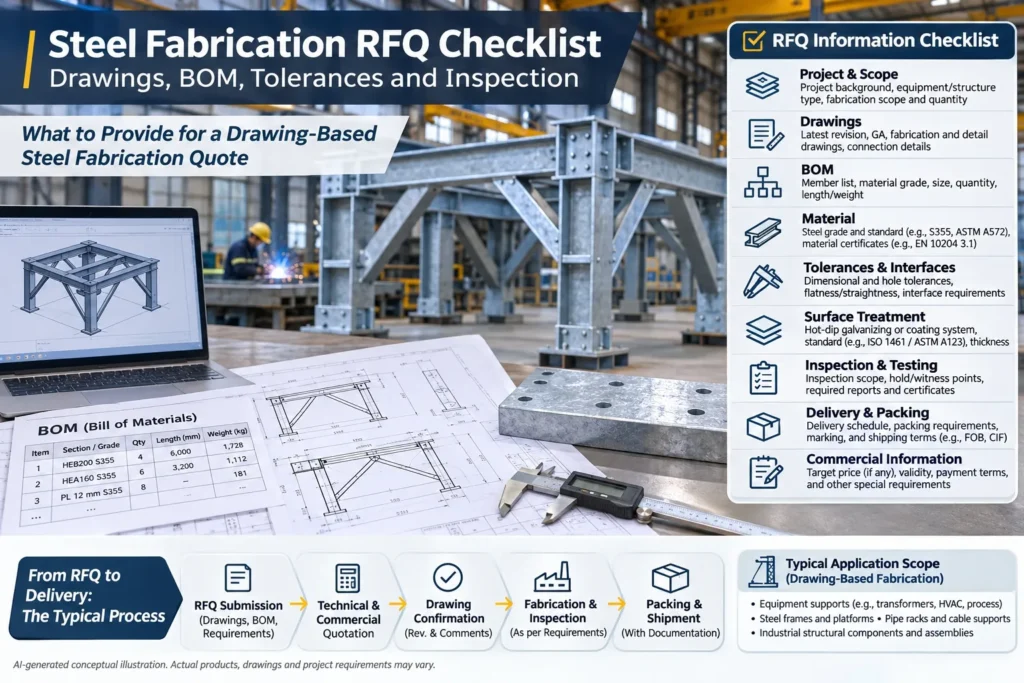
A steel fabrication RFQ checklist should cover the fabrication scope, current drawings, bill of materials (BOM), material specifications, critical dimensions and tolerances, welding requirements, surface treatment, inspection criteria, quantities, and delivery conditions. Buyers should identify which documents are approved, preliminary, or pending clarification. For build-to-print steel frames and equipment supports, mounting interfaces and connection geometry deserve particular attention because dimensional errors can prevent equipment installation. A preliminary RFQ may support budget pricing, but production should not begin until the applicable drawings, technical requirements, and unresolved deviations have been agreed upon.
1. Define the Fabrication Scope Before Requesting a Price
The first question a fabrication supplier needs to answer is simple: What exactly is included in the quotation?
For custom steel fabrication, the scope may cover cutting, drilling, machining, forming, welding, surface treatment, inspection, marking, packing, and transportation.
Not every project requires all these operations.
For example, an OEM requesting welded equipment support frames may supply finished fabrication drawings and require the supplier to manufacture the frames only. Another buyer may expect the supplier to prepare shop drawings, source fasteners, perform trial fit-up, and coordinate coating.
These are different commercial scopes.
| Scope Item | Buyer Should Specify |
| Fabrication | Cutting, drilling, forming, welding, machining |
| Engineering | Build-to-print only or additional detailing/review |
| Materials | Supplier-supplied or buyer-supplied |
| Fasteners | Included, excluded, or separately quoted |
| Surface treatment | Bare steel, paint, hot-dip galvanizing, or other coating |
| Inspection | Routine QC, witness inspection, third-party inspection |
| Giao hàng | Loose components, subassemblies, or finished frames |
| Tài liệu | Required certificates, reports, and shipment records |
Procurement action: Include a scope matrix identifying each operation as included, excluded, or subject to clarification.
Without this agreement, two suppliers may quote different deliverables even when they receive identical drawings.
2. Which Drawings Are Required for a Steel Fabrication RFQ?
Drawings are the foundation of a build-to-print quotation, but a general arrangement drawing alone is not always enough.
A supplier may understand the overall frame dimensions while still lacking the information needed to estimate welding, machining, and inspection.
General Arrangement Drawings
General arrangement (GA) drawings should identify the overall configuration, major dimensions, component locations, assembly orientation, and relevant interfaces.
They help the supplier understand how the fabricated structure fits within the larger equipment or project.
Part and Fabrication Drawings
Part drawings should define individual components and manufacturing details, including:
- Member profiles, plate thicknesses, and cut lengths
- Hole diameters, patterns, slots, and edge distances
- Weld locations, sizes, and applicable symbols
- Bending, machining, and edge preparation requirements
- Material grades and relevant surface requirements
Interface and Installation Drawings
For equipment frames, base frames, and support structures, interface drawings are particularly important.
They should identify mounting-hole patterns, anchor interfaces, equipment contact surfaces, clearance zones, and other dimensions that control installation.
A frame can meet its overall length and width requirements while still failing to align with the equipment it supports.
Drawing Revisions and File Formats
Each drawing should have an identifiable number, revision, and issue status.
PDF drawings are useful for controlled review. CAD files, where available and compatible, can help clarify geometry and improve manufacturing planning. The controlling document and precedence rules should be agreed upon, especially if files disagree.
A preliminary drawing is not automatically unsuitable for quotation. However, it should be labeled accordingly.
| Drawing Status | Appropriate Use |
| Concept or preliminary | Budget estimate with stated assumptions |
| Issued for quotation | Commercial offer with defined qualifications |
| Approved for fabrication | Production subject to agreed release controls |
| Superseded | Reference only; not for new production |
Key rule: Never allow an obsolete drawing revision to remain in the active fabrication package.
3. What Information Should the BOM Contain?
A bill of materials connects the drawings to the quantities, material requirements, and components being priced.
For welded frames or modular equipment supports, the BOM should distinguish fabricated parts from purchased items.
A useful steel fabrication BOM includes:
| BOM Field | Example |
| Item number | P-001 |
| Drawing reference | FR-102, Rev. B |
| Description | Base plate |
| Chất liệu | S355J2, subject to design approval |
| Size | 300 × 250 × 16 mm |
| Quantity per assembly | 4 |
| Number of assemblies | 25 |
| Total quantity | 100 |
| Hoàn thành | As specified in coating schedule |
| Remarks | Machined interface |
Illustrative BOM entries only; not an actual HSD project or approved design.
The BOM should be checked against the drawing package before it is released to suppliers.
Common problems include missing gusset plates, duplicate part numbers, inconsistent material grades, and quantities that do not reflect the required assembly count.
Where a BOM is not yet available, the supplier may be asked to estimate material quantities from drawings. The RFQ should state whether this quantity takeoff is included in the quotation scope and who is responsible for approving it.
4. Specify Materials and Substitution Rules
Material descriptions such as “carbon steel” or “structural steel” are often too broad for a firm fabrication quotation.
The RFQ should identify the required material specification, grade, product form, and any supplementary requirements.
Depending on the project, material requirements may include yield strength, toughness, dimensional standards, traceability, and inspection certificates.
For example, an equipment frame designed around a particular structural steel grade should not be quoted using a different grade without engineering review.
Buyers should also clarify:
- Whether equivalent materials are permitted
- Who approves proposed substitutions
- Whether material certificates are required
- Whether heat-number traceability is necessary
- Whether material supply is included in the supplier’s scope
Material equivalence should be evaluated against the complete design and specification requirements, not simply nominal yield strength.
5. Identify Critical Tolerances and Equipment Interfaces
Not every dimension on a steel frame requires the same manufacturing tolerance.
A general support member may permit more dimensional variation than a machined equipment mounting surface.
The RFQ should distinguish between general fabrication tolerances and critical functional tolerances.
Critical Dimensions to Identify
| Feature | Potential Risk | Verification |
| Mounting-hole pattern | Equipment cannot be bolted down | Hole position and diameter checks |
| Base plate flatness | Poor equipment seating | Flatness measurement |
| Frame diagonals | Assembly out of square | Diagonal measurements |
| Connection alignment | Mating components do not fit | Fit-up or template verification |
| Overall height | Interference with connected equipment | Dimensional inspection |
| Machined surfaces | Improper seating or alignment | Specified dimensional and surface checks |
A tolerance must be interpreted together with its datum system and measurement method.
For example, specifying a hole-position tolerance without defining the reference datums can create disagreement over whether the finished part meets the drawing.
Buyers should identify functional interfaces early and require the supplier to flag any dimensions that cannot be reliably verified using the proposed inspection method.
Before production: Agree on applicable general tolerances, critical dimensions, inspection methods, and acceptance criteria. Do not assume the supplier’s normal workshop tolerances match the equipment designer’s requirements.
6. Define Welding Requirements Before Quotation
Welding can be a major cost and quality factor for fabricated steel frames.
The RFQ should provide the applicable welding code or specification, weld symbols, joint details, and inspection requirements.
Relevant information may include weld size, weld length, joint preparation, accessibility, welding sequence constraints, and any specified post-weld treatment.
The ISO 3834 series addresses quality requirements for fusion welding, with different levels of requirements selected according to the application. ISO 3834-1:2021 explains the selection framework; it does not replace a project-specific welding code or define every weld acceptance criterion.
Welding Questions to Resolve
- Which welding standard and edition apply?
- Are qualified welding procedures and personnel required?
- Are welds subject to visual inspection only or additional NDT?
- Which joints require enhanced inspection?
- Must the supplier submit welding records or qualification documents?
- Are distortion control and post-weld dimensional checks required?
Additional non-destructive testing, such as ultrasonic or magnetic particle testing, should be specified where justified by the design and governing requirements.
Do not automatically request extensive NDT for every weld. The appropriate method and extent depend on joint design, accessibility, service conditions, applicable standards, and contractual acceptance criteria.
7. Specify Coating and Surface Treatment Requirements
Surface treatment affects price, manufacturing sequence, dimensional interfaces, and delivery planning.
Buyers should specify the coating system rather than simply requesting “anti-rust treatment.”
Typical options include bare steel with temporary protection, painted finishes, hot-dip galvanizing, or a project-defined multi-layer system.
For fabricated iron and steel articles, ISO 1461:2022 addresses hot-dip galvanized coating properties and test methods. ASTM A123/A123M-24 covers hot-dip zinc coatings on applicable iron and steel products, including structural fabrications. The governing specification should be selected according to the project and product form.
Coating Information for the RFQ
| Requirement | Information to Provide |
| Coating type | Hot-dip galvanizing, painting, or other |
| Governing standard | Standard number and edition |
| Coating acceptance | Thickness, appearance, testing, repair criteria |
| Surface preparation | Applicable preparation specification |
| Masked areas | Machined surfaces, threads, mating interfaces |
| Coating inspection | Required measurements and records |
| Packaging | Surface protection and separation requirements |
For hot-dip galvanized welded frames, design review should also consider venting, drainage, enclosed sections, distortion risk, and the suitability of critical interfaces.
A coating requirement introduced after fabrication may require additional modifications or rework.
8. Define Inspection and Quality Documentation
A fabrication supplier cannot accurately price inspection activities if the RFQ does not identify what must be checked, witnessed, or documented.
The inspection and test plan (ITP), where required, should define inspection stages, responsibilities, acceptance criteria, and hold or witness points.
Typical Inspection Stages
| Stage | Typical Checks | Potential Records |
| Material receipt | Grade, dimensions, identification | Material certificates |
| Cutting and drilling | Dimensions, hole locations | Dimensional records |
| Fit-up and welding | Joint preparation, alignment, weld quality | Welding and inspection reports |
| Final fabrication | Critical dimensions, assembly geometry | Final dimensional report |
| Surface treatment | Coating condition and specified tests | Coating inspection report |
| Packing | Quantity, identification, protection | Packing list and release records |
Documentation requirements should be proportional to the project.
A simple noncritical support frame may not require the same documentation package as a heavily loaded equipment support with tightly controlled interfaces.
Buyers should identify which records are mandatory, which are available upon request, and which require separately priced inspection activities.
Inspection Requirements Should Be Agreed Before Production
If a buyer requires third-party witnessing, special test reports, or specific inspection hold points, those conditions should be included in the RFQ.
Otherwise, a supplier may quote routine internal inspection while the buyer expects a much more extensive verification process.
9. How Do Packing and Delivery Requirements Affect the Quotation?
Packing and logistics should be addressed before suppliers finalize their offers.
Large welded frames may occupy significant shipping volume even when their steel weight is relatively modest.
Smaller modular frames may be easier to transport but require more site assembly work.
The RFQ should identify:
- Delivery destination and requested Incoterms rule with named place
- Required shipment date or delivery window
- Assembly and disassembly requirements
- Maximum package dimensions or site access restrictions
- Export packing and corrosion protection requirements
- Marking, packing lists, and component identification
- Lifting points or handling instructions where applicable
For overseas projects, buyers should also specify whether components must be grouped by assembly, installation area, or equipment number.
These requirements influence packing design, loading, site receiving, and installation efficiency.
10. Common RFQ Gaps That Cause Rework or Price Changes
| RFQ Gap | Possible Consequence | Recommended Action |
| Missing drawing revisions | Wrong parts manufactured | Issue controlled drawing register |
| Incomplete BOM | Quantity disputes | Reconcile BOM and drawings |
| Undefined critical tolerances | Equipment fit-up problems | Mark critical interfaces |
| Unclear welding requirements | Inconsistent inspection scope | Specify code and acceptance criteria |
| Coating not defined | Additional cost or rework | Confirm system before fabrication |
| Missing inspection scope | Disputes over test costs | Define ITP and records |
| Unclear delivery scope | Freight and packing variations | Specify delivery basis |
The objective is not to eliminate every clarification. It is to make significant assumptions visible before a quotation becomes a purchase order.
11. Steel Fabrication RFQ Checklist: What Must Be Ready?
Use this checklist before submitting a build-to-print fabrication inquiry.
Steel Fabrication RFQ Readiness Checklist
Check the information available for your fabrication inquiry. Missing items can be identified for clarification rather than delaying your initial RFQ.
This checklist is a document-readiness aid, not an engineering approval or supplier qualification. You can submit an initial inquiry even if some information is still pending.
This checklist is a document-readiness aid, not an engineering approval or supplier qualification.
12. How to Request a Steel Fabrication Quote With Your Existing Documents
Not every steel fabrication RFQ comes with a complete BOM, finalized drawings, or a standard purchasing form.
Some buyers send detailed fabrication drawings and technical specifications, while others provide only preliminary drawings, estimated quantities, or a short project description.
You can start a fabrication inquiry with the documents you already have.
What Can You Submit?
- Drawings: Available PDF or CAD files, preferably with revision information.
- BOM or quantities: A material list, part schedule, or estimated order quantity.
- Technical requirements: Available material, welding, tolerance, coating, and inspection specifications.
- Delivery details: Destination, expected schedule, and any special requirements.
These details may be provided through separate files, drawings, or emails. A standardized RFQ form is not mandatory.
What if Some Information Is Missing?
Clearly identify any unconfirmed requirements, such as mounting tolerances, material quantities, or coating specifications.
A preliminary quotation may be possible based on available information and stated assumptions. Additional clarification may be necessary before a firm quotation or production release.
What Should You Do Next?
You can begin a fabrication inquiry with your existing drawings, BOM, or project specifications. Clearly identify any missing or unconfirmed technical requirements so the supplier can review the available information and advise on the next steps.
A complete RFQ package is helpful, but it is not required to start the conversation.
13. How to Compare Steel Fabrication Quotations
The lowest quoted amount is not necessarily the lowest comparable cost.
Before evaluating offers, verify that each supplier has included the same materials, manufacturing operations, coating, inspection, documentation, packing, and delivery scope.
Compare quotations using a common evaluation matrix.
| Evaluation Item | What to Compare |
| Technical compliance | Drawing revisions, material grades, tolerances |
| Fabrication scope | Included operations and exclusions |
| Quality requirements | Inspection coverage and documentation |
| Surface treatment | Coating specification and testing |
| Commercial scope | Tooling, samples, testing, packing, freight |
| Schedule | Stated production and delivery assumptions |
| Deviations | Proposed alternatives and unresolved issues |
Ask suppliers to list deviations separately rather than burying them in quotation notes.
For repeat OEM orders, also confirm how drawing revisions, quantity changes, and nonconforming parts will be managed.
14. Request a Custom Steel Fabrication Quote From HSD Steelwork
Have a steel fabrication project that requires supplier review?
HSD Steelwork welcomes inquiries based on available fabrication drawings, BOMs, and project specifications. Whether your documentation is complete or still under development, you can share the available information for an initial discussion.
Project feasibility, manufacturing scope, technical requirements, and quotation conditions will need to be confirmed during review.
Have a Steel Fabrication Project?
Share your available drawings, BOM, or project specifications with HSD Steelwork. Preliminary documents are welcome for an initial inquiry.
Submit Your Steel Fabrication InquiryProject feasibility and quotation requirements are subject to review.
Frequently Asked Questions
Can I Request a Steel Fabrication Quotation Without a Complete BOM?
Yes. A preliminary quotation may be possible from sufficiently detailed drawings, but material takeoff responsibilities and quantity assumptions should be agreed upon. A completed BOM generally improves quotation comparability.
Are PDF Drawings Enough for a Fabrication RFQ?
PDF drawings may be sufficient for an initial review if they contain the necessary dimensions and manufacturing details. CAD files can be useful for complex geometry, but file formats and document precedence should be confirmed with the supplier.
Do All Dimensions Need Tight Tolerances?
No. Tolerances should reflect functional requirements. Equipment interfaces, mating components, and critical mounting features may require tighter controls than noncritical structural dimensions.
Should Material Certificates Be Included in the Quotation?
If material certificates are required, specify their type and traceability expectations in the RFQ. The actual certificates are normally provided as agreed during material procurement or production documentation.
Is Third-Party Inspection Necessary for Every Fabricated Steel Frame?
Not necessarily. Third-party inspection depends on the application, contractual requirements, project risk, and governing specifications. Buyers should define the inspection scope before quotation.
Can a Supplier Quote Before the Drawings Are Approved for Fabrication?
Yes, for budgetary or qualified commercial purposes. The quotation should identify the drawing status and assumptions. Production release requires the applicable technical documents and outstanding issues to be resolved.
What Causes the Largest Differences Between Steel Fabrication Quotations?
Differences often arise from material selection, fabrication complexity, welding and machining requirements, coating, inspection, quantity, packing, and delivery scope. A common RFQ package helps buyers compare offers on a consistent basis.