


A missing brace, connection plate, bolt package, or tower member may represent only a small fraction of an overseas steel structure shipment. At the erection site, however, that single missing item can stop an assembly sequence and trigger inventory checks, emergency replacement production, air freight, or idle installation labor.
For transmission towers, substation structures, communication towers, and other structures shipped as many individual pieces, preventing shortages requires more than counting bundles before closing the container. The control process should connect approved drawings and the bill of materials (BOM) with member marking, package identification, packing lists, loading records, and receiving checks.

Câu trả lời nhanh
The most effective way to reduce missing member risk in overseas deliveries is to maintain traceability from the approved BOM to the individual steel member, package, container, and final site inventory. Each member should have a consistent identification mark, while bundles and boxes should have package IDs linked to detailed packing lists. Before shipment, quantities should be cross-checked against approved documents and loading records. Small hardware requires separate control because bolts, plates, and fittings are easier to misplace. Loading photos, container records, and receiving procedures provide additional evidence when a discrepancy appears.
Why Missing Members Are an Overseas Project Risk
Steel structures such as lattice transmission towers can contain large numbers of angles, plates, bolts, and other components. Similar-looking members may differ only in length, hole arrangement, thickness, or member mark.
That creates several opportunities for errors.
A member may be fabricated but assigned to the wrong bundle. A correct bundle may be loaded into the wrong container. Small hardware may be packed separately without a clear reference to the main structure. A packing list may reflect planned quantities rather than the final physical load.
The problem becomes more expensive after an international shipment leaves the factory. A local delivery can sometimes be corrected quickly. An overseas shortage may require customs documentation, international courier or air freight, and coordination between the manufacturer, EPC, freight forwarder, and site team.
The objective should therefore be to detect discrepancies before the container is sealed.
1. Start With One Controlled BOM and Drawing Revision
Physical packing control starts with document control.
The fabrication team, QC team, packing team, and project buyer should work from the same approved drawing revision and corresponding BOM or member schedule.
The BOM should identify, as applicable:
- member mark or part number;
- description or section size;
- quantity;
- material or grade reference;
- tower, structure, bay, or assembly reference;
- drawing reference; and
- package information once packing is completed.
Revision control matters because a design change can add, delete, or replace members. If production follows one revision while the packing list follows another, a shipment can appear complete even though it does not match the final approved structure.
Before packing begins, the project team should therefore establish which drawing and BOM revision is the shipment baseline.
2. Give Every Member a Consistent Identification Mark
A physical member should be traceable back to the drawings and member list.
For fabricated tower components, this is commonly achieved through a member mark or piece mark applied using the method agreed for the project. The mark needs to remain readable through handling, galvanizing where applicable, storage, packing, shipment, and site sorting.
The exact marking method should be agreed before production because different specifications can impose different restrictions.
Consistency is more important than creating multiple independent numbering systems. Ideally, the same member identifier appears in:
drawing → BOM → physical member → packing list → site inventory
This allows a site team that finds member A125, for example, to locate the same reference in the project documentation rather than trying to identify the component only by dimensions.
3. Bundle Members According to a Defined Packing Logic
Randomly combining components simply because they fit into one bundle makes quantity control and site erection more difficult.
A better packing plan groups members according to a documented logic such as:
- tower number or tower type;
- structure or bay;
- erection section;
- member family;
- dimensions and handling characteristics;
- installation sequence.
The correct approach depends on the project.
For repeated transmission tower types, grouping according to tower type and erection section may simplify site distribution. For substation structures, packing by bay, gantry, equipment support, or erection sequence may be more practical.
The packing philosophy should therefore be discussed with the buyer before shipment rather than decided solely according to container utilization.

4. Assign a Unique Package Number to Every Bundle or Box
Individual member marking and package marking solve different problems.
The member mark identifies the component. The package number identifies the shipping unit containing it.
Ví dụ:
Tower Type A / Package A-03 / 24 pcs
The packing list can then show exactly which member marks and quantities belong to Package A-03.
A durable package label should contain enough information for the receiving team to connect the physical bundle to the shipment documents. Depending on the contract, useful fields can include:
- project or PO number;
- structure/tower reference;
- package number;
- member range or description;
- quantity;
- gross/net weight where required;
- destination; and
- handling information.
ISO 780:2015 specifies graphical symbols used to communicate handling and storage instructions on distribution packages. Project-specific package identification still needs to be defined separately.
5. Control Bolts and Small Parts Separately
Small components deserve disproportionate attention.
Bolts, nuts, washers, connection plates, clips, shims, and other loose items are easier to lose, mix, or place in the wrong package than long structural members.
Rather than treating hardware as an undefined accessory quantity, buyers should request a clear packing breakdown.
Boxes or crates can be identified by tower type, assembly, bolt specification, or another agreed system. Their quantities should appear on the packing list rather than only on an internal warehouse sheet.
Where moisture protection is necessary, the packing method should also account for the expected storage and transport environment.
6. Cross-Check Physical Packages Against the Packing List
A packing list should describe what has actually been packed, not merely what was scheduled to be packed.
Before shipment, the responsible team should reconcile three sets of information:
approved BOM/member schedule ↔ physical packages ↔ final packing list
Useful checks include verifying that all required member marks appear, quantities agree, package numbers are unique, hardware boxes are included, and no package remains in the staging area after loading.
For large projects, this can be controlled package by package instead of attempting one final count after hundreds of bundles have accumulated.
The principle is simple: detect the discrepancy while the material is still accessible.
7. Record the Container Loading Process
Packing control should continue until the cargo is physically inside the assigned container or transport unit.
The IMO/ILO/UNECE CTU Code provides guidance for packing and securing cargo transport units across intermodal transport chains. It addresses safe loading and securing practices rather than member completeness itself, but it provides an important reference for the physical loading stage.
For traceability, a shipment record can capture:
- container number;
- package numbers loaded;
- loading sequence where relevant
- photographs during loading;
- final condition of the load;
- securing arrangement where required; and
- seal number after closure.
Photographs are particularly useful when package IDs are visible. They create an additional link between the packing list and the actual container contents.
However, photographs should supplement—not replace—quantity verification.
8. Check Wood Packaging Requirements for the Destination
Export shipments may use timber blocks, crates, pallets, or dunnage to support and separate steel members.
ISPM 15 addresses phytosanitary measures for wood packaging material made from raw wood used in international trade, including dunnage. Processed wood materials such as plywood are treated differently under the standard.
The IPPC also notes that implementation is handled through national plant protection organizations, so exporters should confirm the applicable requirements for the destination country rather than assuming one packing practice applies everywhere.
This issue does not directly prevent a steel member from going missing, but non-compliant packaging can create customs or quarantine complications that disrupt the delivery process.
9. Give the Buyer a Package-Level Shipping Record
A useful shipment handover package should allow the buyer to answer:
What was shipped, where was it packed, and where should I find it?
Depending on project requirements, the documentation may include the final packing list, commercial shipping documents, package breakdown, container allocation list, loading photographs, inspection records, and other contractually required certificates.
The package list becomes much more useful when it links each package number to specific members or assemblies.
Instead of:
Package 17 – Steel Members
use a controlled description that enables the site team to determine which structure or member group is inside Package 17.
10. Plan the Receiving Inspection Before the Vessel Arrives
Missing-member control should not end at the port of loading.
The buyer should establish a receiving procedure before cargo reaches the destination. Packages can be checked against the packing list during unloading and then transferred to designated storage areas.
Any discrepancy should be recorded promptly with evidence such as:
- package number;
- container number;
- member mark;
- expected quantity;
- received quantity;
- photographs;
- condition of straps or packaging; and
- date and location of discovery.
This information helps distinguish among several different situations: a member was never packed, a package was misallocated, cargo was damaged or opened in transit, or a component is present on site but stored in another location.
A Practical Pre-Shipment Checklist
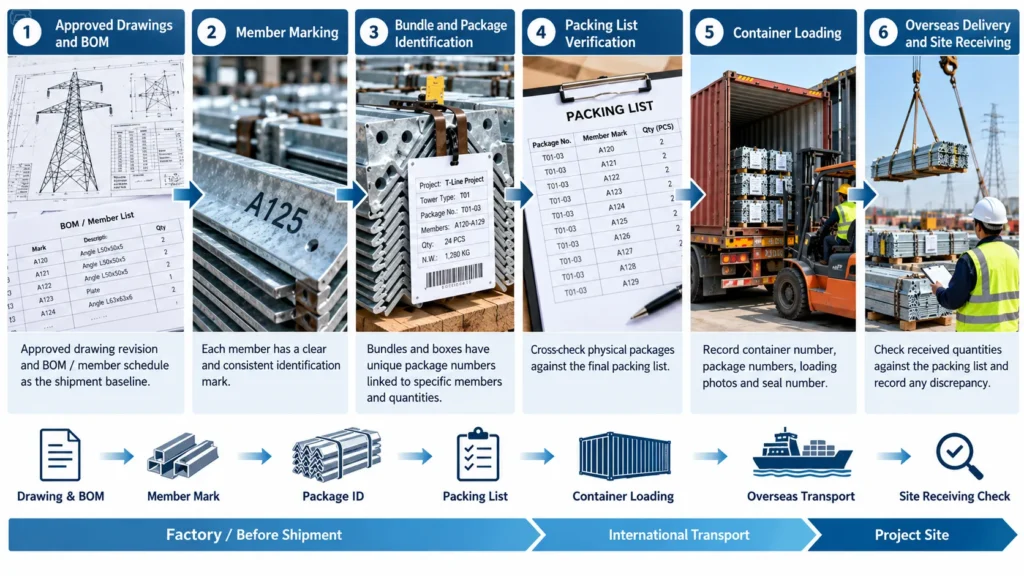
Before approving an overseas steel structure shipment, the buyer or inspector can verify:
- The final packing list uses the approved drawing/BOM revision.
- Member marks correspond with the approved documentation.
- Each bundle, crate, or box has a unique package identifier.
- Package contents and quantities are traceable.
- Bolts and small parts are separately identified and counted.
- Package quantities have been physically checked before loading.
- Container allocation is recorded.
- Loading photographs and relevant inspection records are retained.
- Container and seal numbers are recorded where applicable.
- The receiving team has the final packing list before cargo arrives.
Common Warning Signs During Supplier Inspection
Several conditions deserve further investigation before shipment.
A packing list that only gives total weight without member-level or package-level detail provides limited help during shortage investigation.
Handwritten package numbers that do not correspond to the final packing list can create similar problems.
Another warning sign is a large quantity of loose hardware without structure-specific identification.
Finally, if drawing revisions changed after fabrication started, the inspector should verify how obsolete, replacement, and newly added members were controlled.
These conditions do not automatically mean members are missing. They indicate that traceability is weaker and additional verification may be appropriate.
How HSD Steelwork Relates to This Process
For overseas steel structure projects, packing should support both international transport and efficient site identification.
HSD Steelwork’s published product information states that its substation structures can be “marked & bundled for easy field erection.” Buyers should still define project-specific member marking, package identification, documentation, inspection, and packing requirements in the purchase specification.
For transmission towers, substation structures, monopoles, and related products, see the HSD Steelwork product range.
What to Include in Your RFQ
If missing-member prevention is important to the project, define the requirement before placing the order.
An RFQ can specify the approved drawings and BOM, structure quantities, destination, required member marking system, packing philosophy, package labeling, packing-list format, hardware segregation, inspection hold points, loading records, applicable wood-packaging requirements, and any site erection sequencing requirements.
Early agreement makes the packing system part of project execution instead of a last-minute warehouse activity.
Câu hỏi thường gặp
What is the most important document for preventing missing steel members?
The approved BOM or member schedule is the primary quantity reference, but it should be linked consistently to drawings, physical member marks, package numbers, and the final packing list.
Should every steel member have an identification mark?
For structures containing many similar components, individual member identification greatly improves traceability. The exact marking method should comply with the project specification and agreed fabrication requirements.
Why should every bundle have a separate package number?
A unique package number lets the buyer connect a physical bundle to its documented contents, container allocation, and receiving record.
How should bolts and small hardware be packed?
They should be segregated and clearly identified according to an agreed system such as tower type, assembly, bolt specification, or package number. Quantities should be included in shipment documentation.
Can loading photos prove that every member was shipped?
Not by themselves. Photos are useful supporting evidence, especially when package IDs are visible, but they should accompany physical quantity checks and controlled packing lists.
Does ISPM 15 apply to steel structures?
It concerns regulated wood packaging material associated with international shipments rather than the steel itself. Raw-wood pallets, crates, or dunnage may therefore require compliant treatment and marking depending on the applicable destination requirements.
Request a Packing and Delivery Review
For an overseas steel structure inquiry, provide the project location, approved drawings, BOM/member schedule, structure quantities, destination port or site, packing requirements, inspection requirements, erection sequence, and delivery schedule.
These inputs allow packing and shipment requirements to be reviewed before production and help establish a traceable path from fabrication to site receipt.