


A transmission tower shipment may contain thousands of individual steel members, connection plates, bolts, and accessories. Even a small manufacturing error can create significant problems when these components reach an overseas construction site.
A misplaced hole can prevent a connection from fitting. An incorrect member mark can delay tower assembly. Missing bolts or incomplete packing records can interrupt installation even when the main steel structures have been manufactured correctly.
For EPC contractors and utility buyers, understanding the steel structure manufacturing process is therefore essential to controlling quality, traceability, delivery risks, and site readiness.
Quick Answer: What Is the Steel Structure Manufacturing Process?
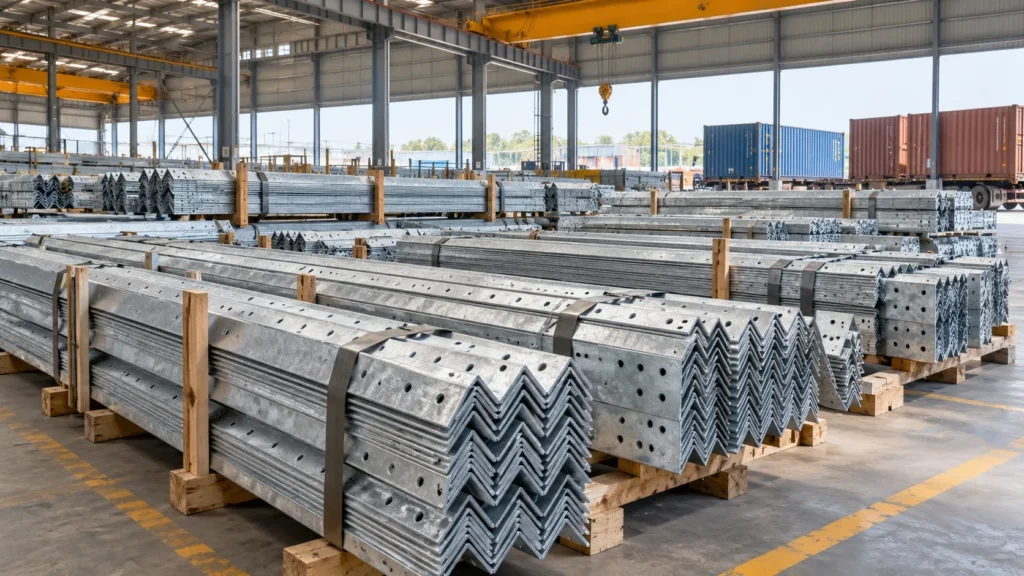
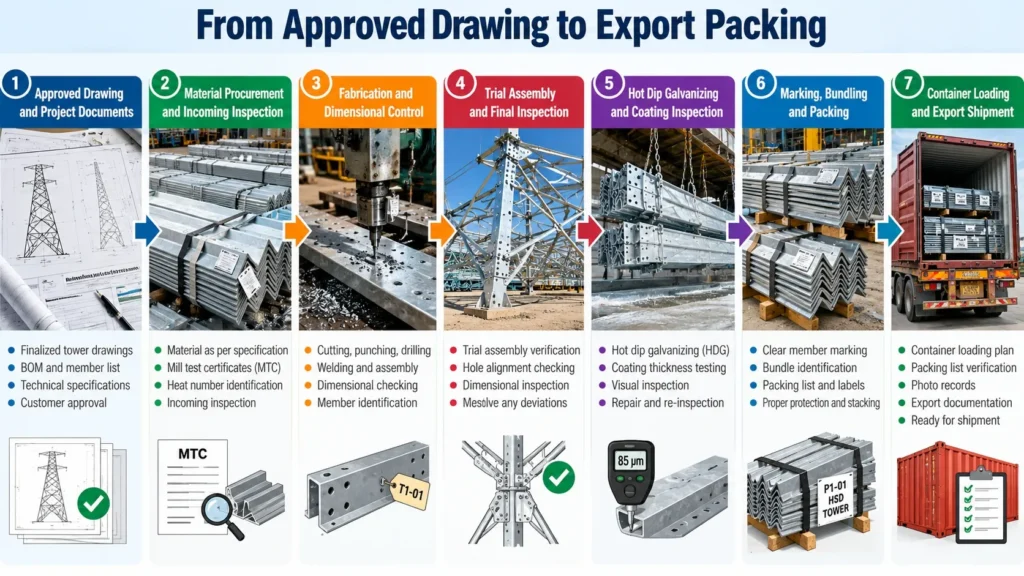
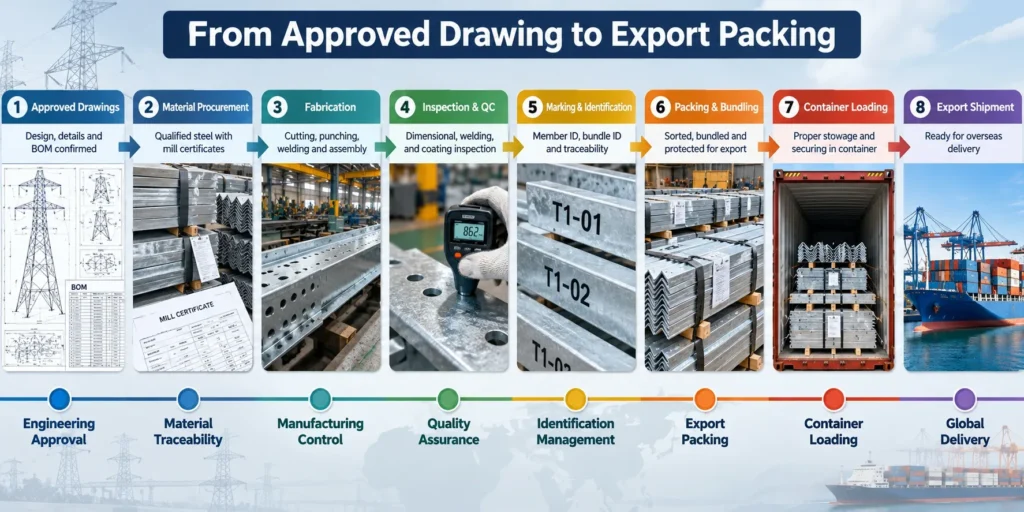
The steel structure manufacturing process typically begins with approved fabrication drawings and a verified bill of materials. Steel is then procured, identified, cut, punched or drilled, and fabricated according to the applicable specifications. Welded components undergo additional controls where required. After dimensional inspection and any specified trial assembly, components may receive hot-dip galvanizing for corrosion protection. Final inspection confirms identification, dimensions, coating condition, quantities, and documentation. The process ends with member marking, bundling, packing-list verification, and export preparation. Each stage should have defined acceptance criteria, traceability requirements, and documented release points before work proceeds.
1. Why Must Manufacturing Start With Approved Drawings?
Approved drawings establish the technical baseline for fabrication.
For transmission towers, the manufacturing information may include:
- General arrangement drawings and tower geometry
- Detailed member fabrication drawings
- Connection details, hole diameters, and hole locations
- Material grades and section sizes
- Bill of materials (BOM) and member identification numbers
- Welding requirements, where applicable
- Galvanizing and inspection specifications
- Applicable dimensional tolerances
A general arrangement drawing alone is not normally sufficient for manufacturing individual tower members.
The manufacturer must work from controlled fabrication information that defines the correct dimensions and connection details.
Drawing revision control
One common production risk is manufacturing different components from different drawing revisions.
For example, a revised connection plate may require an additional bolt hole. If the plate is fabricated from the new drawing but the connecting angle remains based on an obsolete revision, the components may not fit during erection.
Before production release, buyers should confirm that the supplier has a process to identify the current approved revision, withdraw superseded documents, and communicate engineering changes to production and inspection teams.
Recommended control: Establish a drawing register and require formal approval of changes that affect materials, dimensions, connections, or manufacturing status.
2. How Are the Bill of Materials and Production Data Verified?
The BOM connects engineering drawings with physical production quantities.
For a lattice transmission tower, it should identify the required steel members, connection plates, and other components according to the approved project documents.
Typical information includes member mark, section size, material grade, length, quantity, unit weight where specified, and applicable drawing reference.
Before material cutting, the BOM should be checked against the approved fabrication drawings.
Why this matters
An incorrect BOM quantity can produce a shortage even if every manufactured member passes dimensional inspection.
Likewise, duplicate or inconsistent member marks can cause confusion during packing and site assembly.
Buyers should request confirmation that drawing revisions, BOM quantities, fabrication data, and packing requirements are reconciled before repetitive production begins.
3. Material Procurement and Traceability
Steel material selection must follow the approved project specification.
Depending on the structure and design, materials may include structural angles, plates, channels, tubular sections, and other steel products.
The manufacturer should verify the applicable material standard, grade, dimensions, and certificate requirements.
Incoming material inspection
Typical incoming checks include:
- Material grade and specification
- Steel section dimensions and thickness
- Heat number or other traceability identification
- Mill test certificate information
- Visible material condition
- Quantity and receiving records
Material traceability should connect the incoming steel with its inspection documentation and the relevant production batch or fabricated members.
When individual heat-level traceability is required, the identification method must remain effective after cutting.
A material certificate is not sufficient evidence if the manufacturer cannot demonstrate which material was used for the specified components.
4. Cutting, Punching, Drilling, and Member Fabrication
After the material is released, fabrication begins according to approved manufacturing data.
For lattice transmission towers, common operations include cutting steel angles to length, punching or drilling connection holes, preparing connection plates, and marking individual members.
Cutting control
Cutting errors can affect member length, end geometry, and connection fit-up.
Inspection should verify dimensions against the applicable drawing tolerances and identify damage or unacceptable edge conditions.
Punching and drilling control
Connection-hole accuracy is particularly important for bolted structures.
Typical inspection characteristics include hole diameter, hole spacing, edge distance, hole pattern orientation, and burr condition.
An incorrect hole pattern may not become obvious until components are assembled together.
For this reason, first-piece verification and defined in-process inspection are valuable before large quantities of identical members are produced.
Member identification
Each fabricated component should retain an identification mark consistent with the BOM and packing system.
Marking methods and locations must be agreed upon to avoid damaging functional surfaces or creating unacceptable stress concentrations.
5. Welding and Fabricated Assembly Control
Not every transmission tower member requires welding. Many lattice tower systems use predominantly bolted angle-steel connections.
However, welded assemblies may be required for certain base components, support structures, brackets, or tubular steel products.
Where welding is specified, the applicable controls may include approved welding procedures, qualified personnel, joint preparation, fit-up inspection, welding consumable control, visual examination, and specified nondestructive testing.
The project documents should define which welding code applies and which inspection methods and acceptance criteria are required.
Buyer checkpoint: Confirm that welding records can be linked to the relevant fabricated assembly and that required inspections are completed before subsequent processing conceals the weld surface.
6. Why Is Dimensional Inspection Required Before Galvanizing?
Hot-dip galvanizing protects steel against corrosion, but it does not correct inaccurate fabrication.
If a connection plate has incorrect hole spacing before galvanizing, the coating process will not resolve that dimensional error.
Pre-galvanizing inspection should therefore verify relevant characteristics such as:
- Member length and straightness
- Hole diameter, spacing, and alignment
- Plate dimensions and orientation
- Weld quality where applicable
- Surface condition and preparation
- Member marking and identification
- Assembly fit-up where required
Inspectors should record nonconformities and confirm approved corrective action before the affected items proceed.
7. When Should Trial Assembly Be Performed?
Trial assembly is a useful verification method for selected tower types, complex connections, or first-production structures.
It helps identify manufacturing discrepancies that may not be apparent when individual members are inspected separately.
Trial assembly can reveal mismatched hole patterns, incorrect member orientation, interference between components, and discrepancies between drawings and actual fit-up.
The project specification should establish the required scope, inspection points, acceptance criteria, and release authority.
Not every project requires complete trial assembly of every structure. The appropriate extent depends on the design, contractual requirements, and agreed inspection plan.
Any necessary correction should be incorporated into the controlled fabrication documentation before affected production continues.
8. Hot-Dip Galvanizing and Coating Inspection
Hot-dip galvanizing is widely specified for outdoor transmission towers and other steel structures exposed to atmospheric corrosion.
Fabricated steel members are immersed in molten zinc under a controlled galvanizing process.
Two commonly referenced specifications are:
- ISO 1461:2022 — specifications and test methods for hot-dip galvanized coatings on fabricated iron and steel articles.
- ASTM A123/A123M-24 — requirements for hot-dip galvanized coatings on applicable iron and steel products.
The standards have different provisions and should not be treated as automatically interchangeable. The contract must identify the governing specification.
What should galvanizing inspection cover?
The inspection plan should address coating appearance, thickness, continuity, relevant surface defects, and permitted repairs.
Inspectors should also pay attention to holes, edges, connection surfaces, and areas where zinc accumulation may interfere with assembly.
Fasteners may be governed by separate galvanizing standards, so buyers should not automatically apply structural-member requirements to bolts and nuts.
Galvanizing records should identify the inspected lot, applicable specification, results, and any authorized corrective work.
9. Final Quality Inspection Before Packing
Final inspection confirms that manufactured products are suitable for release under the agreed contract requirements.
This should not be limited to visual appearance.
A final inspection plan may cover dimensional records, coating results, member identification, quantities, accessories, outstanding nonconformities, and documentation completeness.
Recommended inspection checkpoints
| Inspection item | Evidence to review |
| Approved drawings | Drawing register and revision status |
| Material conformity | Material certificates and traceability records |
| Fabrication dimensions | Dimensional inspection reports |
| Welding, if applicable | Welding and inspection records |
| Trial assembly, if required | Trial assembly inspection report |
| Paggalvanize | Coating inspection and repair records |
| Member identification | Marking verification against BOM |
| Quantity completeness | Final quantity reconciliation |
| Shipment release | Required approvals and inspection status |
The inspection and test plan should specify witness points and hold points when required by the buyer or third-party inspector.
10. How Should Steel Members Be Marked and Packed for Export?
Export packing is the final physical control stage of the steel structure manufacturing process.
For overseas transmission tower projects, the packaging system must support transportation, unloading, storage, identification, and installation.
Member marking
Each member should be identifiable using the approved marking system.
Marks must correspond with the drawings, BOM, and packing records.
Bundling and packaging
Steel members may be grouped according to tower type, erection sequence, member category, or another agreed logistics plan.
Packaging design should consider bundle weight, lifting points, transport dimensions, coating protection, handling safety, and destination requirements.
Bolts, nuts, washers, and smaller accessories may require separately identified packages with clear quantity records.
Packing list verification
The packing list should identify package numbers, contents, quantities, weights, and other contractual shipping details.
Before loading, the physical packages should be reconciled against the approved shipment list.
11. What Can Go Wrong Between Manufacturing and Export?
| Risk | Possible consequence | Preventive control |
| Obsolete drawing revision | Incorrect components | Controlled drawing release |
| Material identification lost | Uncertain material conformity | Traceability transfer at cutting |
| Incorrect hole positions | Site assembly difficulties | First-piece and dimensional inspection |
| Unresolved trial assembly issue | Repeated fabrication defects | Corrective action before production release |
| Coating defect | Reduced corrosion protection | Inspection to the governing specification |
| Incorrect member mark | Assembly confusion | BOM-to-member verification |
| Missing components | Installation interruption | Packing quantity reconciliation |
| Inadequate bundle protection | Transit damage | Approved packing and handling method |
The most effective approach is to identify the stage where each risk can first be detected, rather than relying entirely on final shipment inspection.
12. What Documents Should Accompany the Shipment?
The required documentation package depends on the contract, governing standards, and inspection and test plan.
A typical buyer-requested package may include approved drawing references, material certificates, traceability records, dimensional inspection reports, welding records where applicable, trial assembly reports where required, galvanizing inspection reports, nonconformity closeout records, packing lists, and release documentation.
Commercial and transport documents, such as invoices, shipping documents, and origin documentation, should be agreed separately according to the transaction and destination requirements.
Buyers should approve the document register before manufacturing begins, not after the cargo is ready to ship.
13. What Should Buyers Confirm Before Production Starts?
Before authorizing manufacturing, EPC and utility procurement teams should resolve these questions:
- Which drawing revisions and BOM will control production?
- What material grades and certificate types are required?
- Which dimensional tolerances and fabrication specifications apply?
- Are welding, trial assembly, or third-party inspection required?
- Which galvanizing standard governs the order?
- How will member and material traceability be maintained?
- What inspection hold points require buyer approval?
- How will packages be identified and reconciled before shipment?
- What documents are required for final release?
- What are the destination, shipping constraints, and required delivery milestones?
These agreements help reduce technical disputes, production interruptions, and missing documentation during shipment release.
14. Request a Steel Structure Manufacturing Review
For transmission tower and related steel structure procurement, buyers should evaluate the complete manufacturing and quality-control process rather than comparing price per ton alone.
A lower initial fabrication price may not represent the lowest project cost if poor identification, incomplete inspection records, or missing components create additional work at the installation site.
HSD Steelwork can be contacted through its official website for project-specific inquiries. Manufacturing capabilities, applicable certifications, inspection arrangements, and delivery commitments should be confirmed directly against current company documentation and the proposed contract.
Planning a transmission tower or steel structure project?
Share your approved drawings, BOM, material specifications, coating requirements, inspection expectations, order quantity, delivery destination, and target schedule with HSD Steelwork for review.
Website: HSD Steelwork
Frequently Asked Questions
1. Can steel structure manufacturing begin before drawings are fully approved?
Preliminary planning or procurement may be possible under an agreed authorization, but fabrication before drawing approval creates rework and revision risks. The buyer and manufacturer should define exactly which activities are permitted.
2. Is trial assembly mandatory for every transmission tower?
Not necessarily. Trial assembly requirements depend on the design, project specification, contract, and inspection plan. Buyers should agree on the extent of assembly verification before production.
3. Should tower members be inspected before or after galvanizing?
Both stages serve different purposes. Pre-galvanizing inspection focuses on fabrication conformity, while post-galvanizing inspection checks the coating and any affected functional features.
4. How can buyers reduce missing-member risks in overseas shipments?
Use consistent member identification, verified BOM quantities, unique package numbers, detailed packing lists, and physical reconciliation before loading.
5. Are material certificates enough to prove steel traceability?
No. Certificates provide material information, but effective traceability also requires an identification system linking the relevant material to the manufactured components.
6. Does a galvanizing certificate guarantee acceptable coating quality?
A certificate alone is not conclusive. Buyers should review the applicable standard, inspection scope, measurement records, acceptance criteria, and any repair documentation.
7. What information is needed to request a manufacturing quotation?
Provide drawings, BOM, material grades, coating specification, applicable standards, inspection requirements, quantities, packing expectations, delivery destination, and required schedule.