


A steel tower quotation can look complete while missing the environmental data that determines whether the proposed structure is suitable for its site.
Two transmission towers may have similar heights and configurations but require different structural designs because of wind exposure, conductor tension, ice accretion, or seismic conditions. These differences affect member sizes, connections, foundations, fabrication quantities, and project cost.
For EPC contractors and utility buyers, the practical challenge is knowing which load inputs must be established before requesting a meaningful technical and commercial proposal.
Quick Answer: What Load Inputs Should Buyers Provide?
Buyers should provide the governing design code, project location, design life or reliability requirements, wind speed and its code-defined basis, terrain and exposure conditions, ice thickness or ice loading criteria, and seismic hazard parameters where applicable. Transmission line projects also require conductor and ground-wire data, span geometry, tension conditions, and relevant broken-wire or unbalanced-load cases. Substation projects may require equipment weights, support reactions, and dynamic interface requirements. These inputs should be documented in an approved design criteria sheet or project specification, with the responsible engineer identifying load combinations and acceptance requirements before structural design and final pricing.

Why Do Environmental Load Inputs Matter Before Quotation?
Wind, ice, and earthquake effects are not interchangeable design inputs.
Wind loading depends on more than a single wind speed. Ice accumulation changes the exposed diameter and weight of conductors and structural components. Seismic effects depend on site hazard, ground conditions, structural dynamic behavior, and applicable design rules.
If these inputs are incomplete, a supplier may need to issue a budgetary estimate based on stated assumptions rather than a technically finalized proposal.
| Missing Input | Potential Consequence |
| Wind speed basis | Incorrect wind pressure or inconsistent design assumptions |
| Terrain exposure | Incorrect representation of site wind conditions |
| Ice thickness and density | Incorrect conductor weight or projected area |
| Conductor tension and span data | Incomplete tower load cases |
| Seismic site parameters | Incorrect seismic demand or structural response assumptions |
| Governing load combinations | Inconsistent member and connection design |
| Approved design criteria | Technical disagreements during design review |
The goal is not simply to provide more data. It is to provide data that is consistent, traceable, and usable under the governing design standard.
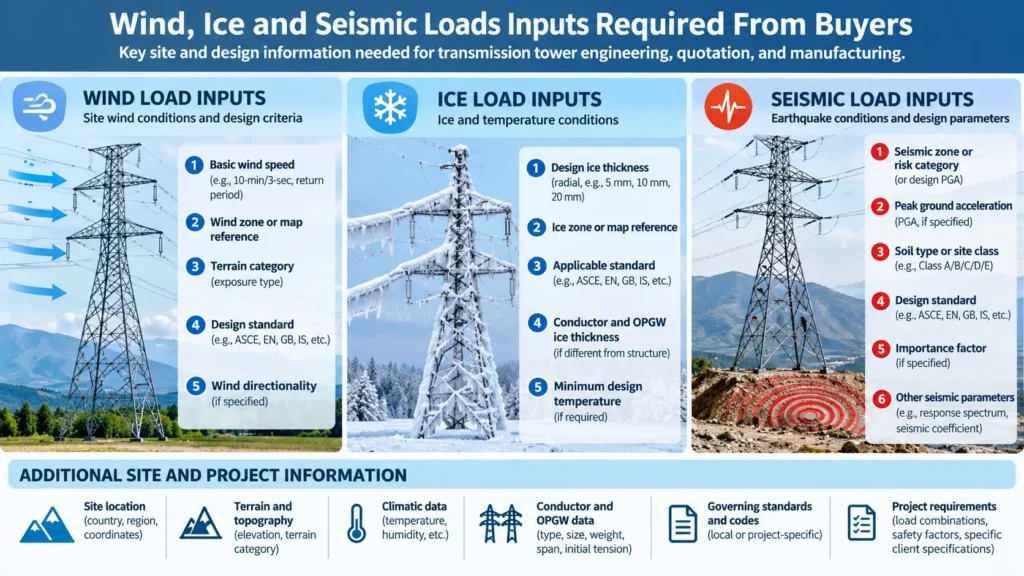
1. What Wind Load Inputs Should Buyers Provide?
Wind loading is often a major design consideration for transmission towers, substation gantries, and other exposed steel structures.
However, the statement “design wind speed: 40 m/s” is not sufficient by itself.
The buyer should identify the basis of that value and the rules used to convert it into design actions.
Basic Wind Speed and Measurement Basis
The project design criteria should identify:
- Basic or reference wind speed and its units
- Averaging time, such as a 3-second gust or 10-minute mean
- Reference height and exposure conditions
- Return period or reliability basis
- Governing wind map, site study, or specification
- Applicable standard and edition
Wind speeds defined using different averaging periods or statistical bases cannot be treated as equivalent without an approved conversion methodology.
For example, an ASCE-based project and an IEC-based transmission line project may use different wind definitions and reliability procedures.
Terrain, Exposure, and Topography
Wind action can change with surrounding terrain.
A tower in open coastal terrain may experience different wind conditions from one located within a sheltered inland environment, even where a regional wind map indicates the same reference speed.
Buyers should provide the governing exposure classification, terrain roughness, topographic effects, and any required wind-direction factors.
Where the route crosses multiple terrain categories, the design team should identify whether different tower locations require different loading assumptions.
Wind Direction and Structural Components
The project specification should also clarify the required wind directions and load cases.
For lattice towers, wind can act on the tower body, crossarms, conductors, insulators, and attached equipment.
The resulting structural effects depend on projected areas, aerodynamic coefficients, conductor spans, and the arrangement of the transmission line.
A tower-body wind load alone does not represent the complete loading system.
2. What Ice Load Inputs Are Required?
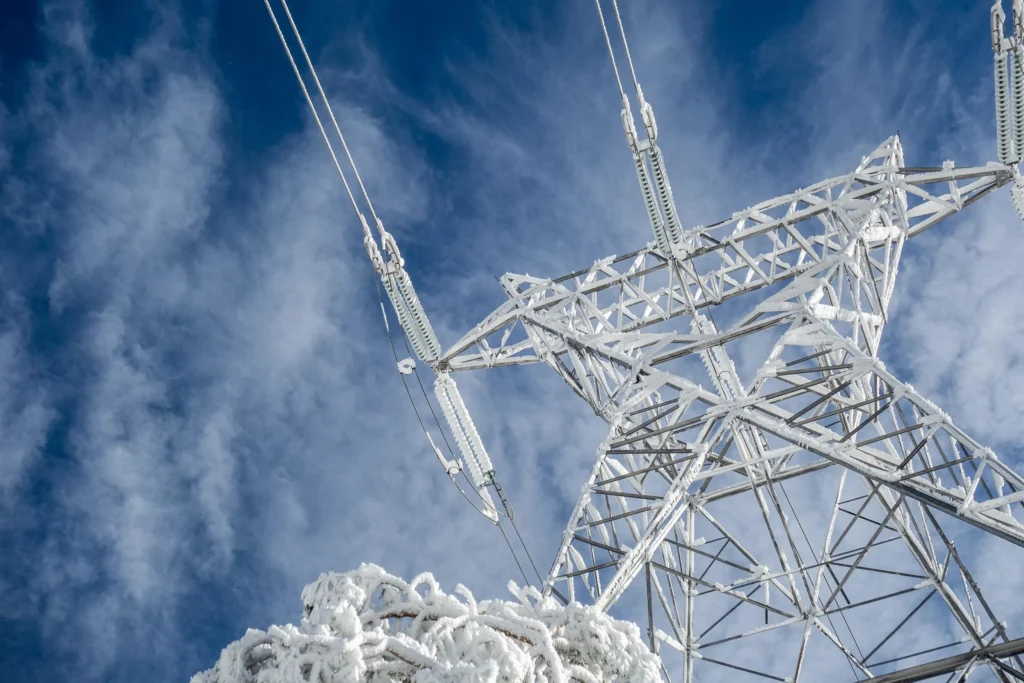
Ice accumulation is particularly important for transmission lines in cold, mountainous, and other icing-prone regions.
The engineering problem is not limited to the additional vertical weight of ice.
Ice can also increase the projected area exposed to wind and create unequal loading between spans.
Ice Thickness, Density, and Accretion Basis
Buyers should specify:
- Design radial ice thickness or equivalent ice load
- Ice density or the governing standard’s assumed value
- Reference elevation or site conditions, where relevant
- Applicable return period or reliability criteria
- Whether ice thickness varies by route section
- Required wind-on-ice conditions
- Any project-specific icing scenarios
The design team should establish whether the stated thickness applies to conductors, ground wires, optical ground wires, or other components.
The use of a single ice thickness for every project location should not be assumed.
Conductor and Ground-Wire Information
Ice loads cannot be evaluated correctly without the physical characteristics of the supported cables.
The buyer should provide the approved conductor schedule, including conductor type, diameter, mass per unit length, mechanical properties, and relevant tension conditions.
Ground wires and optical ground wires require corresponding information.
For transmission tower procurement, span lengths and line angles are also essential because they influence the loads transmitted to the structure.
Unequal Ice and Unbalanced Loading
Uniform ice loading is only one possible design condition.
Depending on the governing code and project specification, the design may need to consider unequal ice accumulation, unbalanced conductor tension, broken-wire conditions, or other abnormal loading scenarios.
These cases can generate significant longitudinal or torsional effects.
Buyers should not assume that a tower designed for uniform vertical ice loading has automatically been checked for all relevant unbalanced cases.
3. What Seismic Load Inputs Should Buyers Provide?
Seismic requirements are project-specific and depend on the applicable structural standard, site hazard, and foundation conditions.
A single peak ground acceleration value does not necessarily provide enough information for seismic design.
Seismic Hazard Parameters
Where seismic design is required, buyers should provide the governing hazard information, which may include:
- Project location and seismic hazard reference
- Peak ground acceleration, where specified
- Design response spectrum or spectral acceleration parameters
- Hazard return period or performance objective
- Site class or ground classification
- Importance or reliability classification
- Required seismic analysis method
- Applicable code edition and national requirements
The precise input format depends on the adopted seismic standard.
For example, ASCE 7 and Eurocode 8 use different frameworks for establishing seismic design actions.
Geotechnical and Foundation Information
Soil conditions can affect seismic demand and the response of foundations.
Buyers should provide available geotechnical investigation reports, relevant soil classification, foundation design criteria, and any site-specific seismic study.
Potential liquefaction, slope instability, or ground deformation hazards should be addressed by the responsible geotechnical and structural engineers where applicable.
Steel tower fabrication drawings alone are not sufficient to establish these ground-related requirements.
Equipment and Connection Interfaces
For substation steel structures, seismic performance can also depend on the supported electrical equipment and its connection to the steel support.
Relevant information may include equipment mass, center of gravity, attachment geometry, equipment qualification requirements, and allowable interface reactions.
The support structure and equipment should be assessed using compatible design assumptions.
4. Why Must Load Combinations Be Defined?
Wind, ice, and seismic actions are not necessarily applied together at their individual maximum design values.
The governing standard establishes which actions must be considered simultaneously, together with the appropriate load factors, combination factors, and reliability requirements.
For transmission towers, the required cases may also include conductor tension, construction loads, maintenance loads, broken-wire scenarios, and other project-defined conditions.
For substation structures, equipment dead loads, operating forces, short-circuit-related actions, and installation conditions may also be relevant.
Buyers should therefore provide either an approved load combination schedule or the design criteria that clearly assign responsibility for developing and approving it.
A supplier should not independently invent the governing combinations when the engineering responsibility has not been established.
5. How Do Load Inputs Affect Steel Tower Cost?
Environmental design requirements can influence both structural quantities and project execution.
Higher design demands may lead to changes in member sections, connection details, foundations, fabrication complexity, or inspection requirements.
However, a higher nominal wind speed or seismic hazard value does not automatically translate into a predictable percentage increase in steel weight.
The outcome depends on the full structural system and governing load cases.
| Design Factor | Possible Procurement Impact |
| Wind demand | Member forces, crossarm design, connection requirements |
| Ice accumulation | Conductor loads, tower geometry, longitudinal forces |
| Seismic requirements | Structural response, anchorage, foundation interfaces |
| Load combinations | Governing member sizes and connection design |
| Route variations | Multiple tower loading schedules or structural variants |
| Late design changes | Drawing revisions, material changes, and schedule risk |
Buyers should compare supplier quotations against the same approved design basis.
Otherwise, differences in price may reflect different assumptions rather than genuine manufacturing cost differences.
6. Which Design Standards Should Buyers Identify?
The governing standard must be established before comparing engineering proposals.
For overhead transmission lines, IEC 60826:2017 provides a reliability-based framework for loading and strength requirements. It also recognizes the need for national climatic data and country-specific provisions. It does not replace detailed component design standards.
IEC
For buildings and other structures, ASCE/SEI 7-22 addresses wind, atmospheric ice, seismic actions, and load combinations within its scope.
ASCE
Other projects may specify European, national, utility, or contract-specific standards. Buyers should confirm applicability rather than assume that one standard covers every transmission line or substation component.
A useful RFQ identifies the standard number, edition, amendments, national annexes where applicable, and any utility-specific deviations.
7. What Documents Should Accompany the RFQ?
A technical RFQ should make it possible to trace the load requirements from their original source to the proposed structural design.
The following documents are particularly useful:
- Approved project design criteria and environmental loading specification
- Route survey and tower spotting schedule
- Conductor, ground-wire, and insulator data sheets
- Tower geometry, loading trees, and general arrangement drawings
- Wind, ice, and seismic hazard studies where required
- Geotechnical investigation and foundation interface requirements
- Load case and load combination schedules
- Applicable design standards and utility specifications
- Structural analysis reports or approved design calculations, if available
- Inspection, documentation, and approval requirements
Buyers should also distinguish between information provided for reference and information formally approved for design.
8. Practical Wind, Ice, and Seismic RFQ Checklist
Buyer RFQ Readiness
Project basis
[ ] Project location and governing code edition
[ ] Design reliability or importance requirements
[ ] Tower type, geometry, and route conditions
Wind inputs
[ ] Reference wind speed and averaging period
[ ] Terrain, exposure, topography, and direction criteria
[ ] Wind-on-conductor and wind-on-structure requirements
Ice inputs
[ ] Radial ice thickness or equivalent load
[ ] Ice density and temperature criteria
[ ] Wind-on-ice and unbalanced loading cases
[ ] Conductor and ground-wire characteristics
Seismic inputs
[ ] Seismic hazard parameters or design spectrum
[ ] Site classification and geotechnical report
[ ] Foundation and equipment interface requirements
RFQ documentation
[ ] Approved loading trees and load combinations
[ ] Engineering responsibility and approval matrix
[ ] Quantity, delivery location, and required schedule
This checklist supports RFQ preparation. It is not a substitute for project-specific engineering approval.
9. How Can Buyers Avoid Load-Related Procurement Errors?
One common error is comparing quotations prepared using different environmental loading assumptions.
Another is issuing fabrication drawings before the final load cases and structural design have been approved.
Buyers can reduce these risks by requiring a documented design-basis review before commercial and production commitments.
During supplier clarification, ask who is responsible for calculating loads, who approves the structural analysis, how revisions are controlled, and whether the quotation is based on preliminary or approved drawings.
Where tower loads change, the responsible engineer should evaluate the implications for members, connections, foundations, and relevant interfaces before approving changes.
10. Preparing a Steel Structure Inquiry for HSD Steelwork
When contacting HSD Steelwork about a transmission tower or substation steel structure requirement, buyers should provide the project location, applicable design standard, available loading documents, drawings, quantities, and delivery requirements.
Where environmental load criteria are not yet finalized, identify which parameters remain preliminary and which party is responsible for completing the engineering work.
This allows the technical scope and outstanding questions to be discussed before quotation assumptions are finalized.
Request a Technical Review for Your Steel Structure RFQ
Visit HSD Steelwork to begin a project inquiry. Include the wind, ice, and seismic requirements together with the available project documents.
Pertanyaan yang Sering Diajukan
1. Is basic wind speed enough to design a transmission tower?
No. The governing wind speed definition, exposure, topography, conductor characteristics, and applicable load cases must also be established.
2. Should wind and ice loads be considered together?
Yes, where required by the governing design standard and project conditions. The applicable concurrent wind and ice parameters must be established rather than combining independent maximum values arbitrarily.
3. Does every transmission tower require seismic analysis?
Not necessarily. The requirement depends on the project location, applicable code, structural system, and owner specifications. The responsible engineer should determine the required seismic assessment.
4. Can suppliers estimate tower weight using only wind speed and tower height?
Only a preliminary estimate may be possible. A reliable structural quantity assessment requires the relevant geometry, conductor loading, load cases, design criteria, and engineering scope.
5. What is the difference between a loading tree and a wind speed specification?
A wind speed specification defines part of the environmental design basis. A loading tree presents structural forces and sometimes moments at specified tower attachment points for defined load cases.
6. Who should approve environmental design inputs?
The project-designated responsible engineer or approving authority should confirm the governing criteria, according to the contract, applicable regulations, and project approval procedure.
7. Can the same wind, ice, and seismic criteria be used for all towers on one transmission line?
Not automatically. Route elevation, exposure, icing conditions, ground classification, and tower function may vary. The design team should determine where different criteria or load schedules are required.
Produk Terkait untuk Proyek Anda
Kirimkan gambar dan persyaratan proyek untuk mendapatkan penawaran harga