





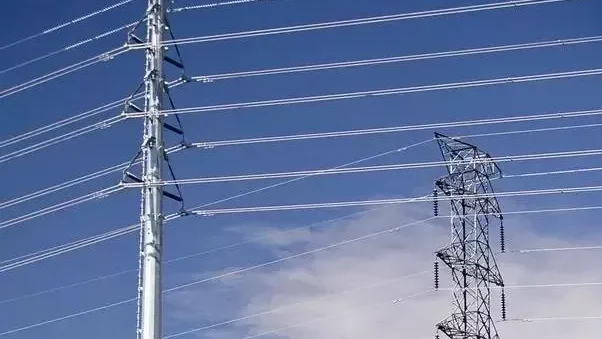
Selecting a transmission tower involves more than comparing steel prices. The structural configuration affects fabrication, foundation design, transportation, site assembly, inspection, and long-term maintenance.
An angle steel tower and a tubular tower can both be engineered for overhead transmission applications, but they introduce different design and procurement considerations.
For EPC contractors and utility buyers, the practical question is not which structure is universally superior. It is which configuration meets the project’s technical requirements while controlling total installed cost and delivery risk.
Quick Answer: Angle Steel Tower vs. Tubular Tower
An angle steel tower uses interconnected steel angle members to form a lattice structure. A tubular tower uses hollow steel sections and may be designed as a tubular lattice structure or a single-shaft steel pole. Angle steel lattice towers offer a segmented construction approach with numerous bolted connections, while tubular alternatives can provide different structural configurations and site assembly requirements. Neither is automatically lighter, stronger, cheaper, or easier to install. The appropriate choice depends on transmission voltage, conductor arrangement, design loads, available land, foundation conditions, fabrication requirements, transportation constraints, and total installed cost.
1.What Is an Angle Steel Tower?
An angle steel tower is a lattice structure assembled primarily from steel angle sections.
Individual members are connected through bolted joints, often using gusset plates or other engineered connection details. The resulting framework transfers loads through a system of interconnected structural members.
Angle steel towers are used for overhead power transmission and other infrastructure applications where lattice construction is appropriate.
Typical structural components include:
- Main leg members and bracing angles.
- Crossarms and conductor attachment assemblies.
- Gusset plates and connection plates.
- Bolts, nuts, and washers.
- Base connections and foundation interfaces.
The exact configuration depends on the tower’s function, including suspension, angle, tension, or terminal applications.
Why does the lat tice configuration matter?
A lattice structure divides loads among multiple interconnected members.
This arrangement allows engineers to select different member sizes for different force demands. However, it also creates numerous connection points requiring accurate fabrication, identification, and assembly.
Member slenderness, connection eccentricity, buckling, and load redistribution must be addressed through the applicable structural design method.
ASCE 10 provides requirements for the design, fabrication, and full-scale testing of lattice steel electrical transmission structures.https://ascelibrary.org/doi/book/10.1061/asce10
2. What Is a Tubular Steel Tower?
A tubular steel tower uses hollow steel structural sections rather than relying primarily on open angle sections.
The term can describe two different configurations.
Tubular lattice tower: A framework made from tubular members connected through engineered joints.
Tubular steel pole: A single-shaft or multipole structure, often fabricated from formed steel plate sections.
These structures should not be treated as identical during technical evaluation.
For example, a tubular lattice tower may require substantial joint welding and bolted assembly, while a monopole transfers loads through a comparatively compact shaft and its foundation connection.
ASCE 48 addresses the design, detailing, fabrication, testing, assembly, and erection of tubular steel transmission pole structures. Its scope should not automatically be extended to every tubular lattice configuration.https://ascelibrary.org/doi/book/10.1061/asce48
3. Angle Steel Tower vs. Tubular Tower: Main Differences
The following comparison focuses on typical engineering and procurement characteristics rather than guaranteed performance.
| Factor | Angle steel lattice tower | Tubular tower |
| Primary members | Steel angles | Hollow steel sections |
| Konfigurasi | Open lattice | Tubular lattice or pole |
| Connections | Numerous bolted joints | Welded and/or bolted joints |
| Fabrication | Cutting, drilling, marking, assembly | Tube production or plate forming, welding, connection fabrication |
| Transport | Individual members can be bundled | Depends on tubular section lengths and diameters |
| Installation | Member or panel assembly | Depends on whether lattice or pole |
| Inspection focus | Holes, fit-up, members, bolts | Welds, geometry, joints, connections |
| Foundation | Depends on reactions and leg arrangement | Depends on shaft arrangement and reactions |
| Cost | Project-specific | Project-specific |
The distinction between tubular lattice towers and monopoles is particularly important for transport, foundation, and erection comparisons.
A monopole may have fewer main structural pieces, but large shaft sections can create transportation and lifting constraints.
An angle steel lattice tower may use smaller transportable members while requiring more field assembly.
Neither arrangement guarantees a shorter installation schedule.
4.Which Tower Has Better Structural Performance?
Structural performance cannot be determined from the member shape alone.
The engineer must evaluate the complete structural system, including member dimensions, steel grades, connections, load combinations, foundation stiffness, and applicable design requirements.
Wind and conductor loads
Transmission towers are subjected to forces associated with conductors, ground wires, wind, and other project-specific loading conditions.
Depending on the location and governing criteria, ice loading, broken-wire conditions, construction loads, and seismic actions may also require consideration.
Both angle and tubular configurations must be checked against the applicable design cases.
A tubular section may offer useful geometric characteristics for certain loading conditions, but that does not establish that every tubular tower will outperform an angle steel tower.
Buckling and member stability
Compression members require particular attention.
Angle members may be affected by slenderness and connection eccentricity. Tubular members also require checks for global and local buckling.
The governing failure modes depend on geometry, material properties, member length, restraints, and connection details.
Foundation requirements
Tower type influences foundation design, but foundation cost cannot be inferred from tower weight alone.
An angle steel lattice tower may transfer loads through several separated legs.
A monopole typically concentrates structural actions at a central foundation interface.
Soil conditions, overturning moments, uplift, lateral loads, constructability, and foundation type determine the actual foundation solution.
Procurement recommendation: Request structural calculations and foundation reactions for both alternatives under identical design criteria before comparing their foundation costs.
5.How Do Manufacturing Requirements Differ?
Manufacturing differences affect production planning, inspection, and dimensional control.
Angle steel tower fabrication
A typical fabrication sequence includes:
- Material identification and verification.
- Cutting angle sections to specified lengths.
- Drilling or punching connection holes where permitted.
- Fabricating gusset plates and connection components.
- Checking member dimensions and hole positions.
- Trial assembly where specified.
- Surface preparation and galvanizing.
- Final inspection, marking, and packing.
The manufacturing team must maintain traceability between drawings, individual members, and assembly marks.
Incorrect hole positions or missing member identification can create significant installation problems.
Tubular tower fabrication
The process depends on the tubular configuration.
For fabricated steel poles, production may involve plate cutting, forming, longitudinal welding, section assembly, flange fabrication, and dimensional inspection.
Tubular lattice members require appropriate tube production or sourcing, end preparation, connection fabrication, and welding or bolting.
Critical inspection points may include:
- Tube dimensions and wall thickness.
- Weld preparation and fit-up.
- Weld inspection and required nondestructive testing.
- Straightness and section geometry.
- Flange alignment and connection dimensions.
- Surface treatment and coating condition.
Welding procedures, welder qualifications, and nondestructive examination requirements must follow the contractually specified standards.
A supplier should not substitute visual inspection for required nondestructive testing.
6. Galvanizing and Corrosion Protection
Both angle steel and tubular steel structures may use hot-dip galvanizing for corrosion protection.
ASTM A123/A123M covers hot-dip galvanized coatings on specified iron and steel products, including certain fabricated structural assemblies. Separate requirements apply to relevant hardware under ASTM A153/A153M.
The project specification must establish the applicable coating standard, required acceptance criteria, and inspection methods.
For angle steel towers, inspectors should examine:
- Coating coverage around holes and edges.
- Connection surfaces.
- Coating damage during handling.
- Member identification after galvanizing.
For tubular structures, additional attention may be necessary for:
- Internal surfaces where galvanizing is specified.
- Venting and drainage provisions.
- Welded connections.
- Trapped solutions or inaccessible cavities.
- Distortion after galvanizing.
Venting and drainage arrangements should be agreed upon before fabrication, rather than improvised after welding.
Corrosion protection performance depends on the actual environment, coating system, design details, damage, and maintenance.
Neither tower type should be assigned a guaranteed service life without project-specific evidence.
7. Transportation and Installation: Which Is Easier?
Transportability is often a decisive issue for remote transmission projects.
Angle steel towers can be divided into relatively small members and bundled according to erection sequence.
This can simplify certain shipping and access arrangements, although the large number of individual components increases the importance of packing accuracy and inventory control.
Tubular lattice towers may also be shipped as separate members.
Tubular monopoles, however, can require large shaft sections that must be checked against container dimensions, road restrictions, turning clearances, and crane capacity.
Questions to resolve before ordering
- What is the maximum transportable component length?
- Are there restrictions on road width or bridge loading?
- Can the erection site accommodate the required crane?
- Will assembly occur on the ground or at elevation?
- Are temporary supports or special lifting fixtures necessary?
- How will components be identified and delivered in erection order?
A tower with fewer components is not necessarily faster to erect if it requires specialized lifting equipment or difficult site access.
Compare complete erection methods, not simply the number of pieces.
8. Angle Steel Tower vs. Tubular Tower Cost
A reliable cost comparison should consider the total installed cost rather than steel price per ton.
The relevant cost categories include:
| Cost category | Evaluation requirement |
| Steel materials | Approved grade, quantity, and procurement price |
| Fabrication | Cutting, drilling, forming, welding, and assembly |
| Surface protection | Galvanizing and other specified coating |
| Inspection | Testing, dimensional checks, and documentation |
| Transportation | Packing, freight, and oversized cargo |
| Foundation | Excavation, concrete, reinforcement, and installation |
| Erection | Labor, cranes, access, and equipment |
| Maintenance | Inspection, coating repairs, and component replacement |
An angle steel tower may offer favorable fabrication economics under certain production and design conditions, but a high number of members and connections can increase assembly work.
A tubular alternative may reduce some assembly operations while introducing more demanding forming, welding, transportation, or lifting requirements.
The actual difference depends on the design and supplier quotations.
For a fair comparison, request two proposals using the same electrical clearances, loading assumptions, design life requirements, site conditions, and delivery scope.
Avoid comparing a material-only quotation for one tower with an installed-price quotation for another.
9. Quality Inspection: What Should Buyers Check?
Inspection requirements should be defined before manufacturing begins.
The inspection and test plan should identify the relevant hold points, acceptance criteria, responsible parties, and required records.
Angle steel tower inspection checklist
- Verify steel grade and material certificates.
- Check member lengths and section dimensions.
- Inspect hole diameter and positioning.
- Confirm member markings.
- Examine connection plate dimensions.
- Verify trial assembly where required.
- Check galvanizing against the agreed specification.
- Confirm bolt and hardware specifications.
Tubular tower inspection checklist
- Verify material grade and wall thickness.
- Check tube or pole geometry.
- Review welding procedures and qualifications.
- Perform specified weld examinations.
- Inspect flanges and connection alignment.
- Verify coating coverage.
- Confirm section identification.
- Review lifting and transport provisions.
For either structure, inspection results should be traceable to the relevant component or production batch.
A generic certificate stating that a tower passed inspection is not a substitute for the records required by the purchase contract.
10. Common Procurement Risks and How to Prevent Them
Several problems can affect both tower types.
| Risk | Preventive action |
| Incomplete design inputs | Freeze the design basis before production |
| Incorrect material substitution | Require written approval and traceable certificates |
| Dimensional mismatch | Agree on tolerances and trial assembly requirements |
| Coating defects | Specify coating acceptance and inspection |
| Missing components | Use packing lists linked to assembly marks |
| Unclear inspection scope | Approve the inspection and test plan |
| Transport restrictions | Review shipping dimensions before fabrication |
| Installation delays | Coordinate erection sequence and site access |
One particularly expensive mistake is approving fabrication before the tower geometry and connection drawings are finalized.
Late revisions can affect materials, hole patterns, welding, galvanizing, and delivery schedules.
Establish a formal drawing revision and approval process.
11. What Documents Should a Tower Supplier Provide?
The required documentation should be established in the purchase order.
Depending on the project, the package may include:
- Approved general arrangement drawings.
- Structural design calculations and foundation reactions.
- Detailed fabrication and connection drawings.
- Material certificates.
- Welding procedure and qualification records, where applicable.
- Nondestructive testing reports, where specified.
- Dimensional inspection reports.
- Galvanizing inspection records.
- Trial assembly records, where required.
- Packing lists and component identification records.
Not every document applies to every structure or supply scope.
The buyer and supplier should agree on the document register and approval requirements before manufacturing.
12. How Should You Choose Between Angle Steel and Tubular Towers?
The selection should follow a defined engineering and procurement process.
Tower selection workflow
- Define electrical requirements
- Establish voltage, conductor arrangement, clearances, attachment heights, and tower function.
- Confirm design conditions
- Identify governing loads, terrain, environmental exposure, and geotechnical information.
- Develop comparable structural alternatives
- Evaluate feasible angle lattice, tubular lattice, and pole configurations where appropriate.
- Assess project execution
- Review manufacturing, shipping, access, foundation construction, and erection.
- Compare total project cost and risk
- Use consistent quotation scopes, approved designs, inspection requirements, and schedules.
13.Request a Project-Specific Tower Quotation
HSD Steelwork can be contacted through its website to discuss project requirements and confirm the appropriate supply scope.
For an efficient technical and commercial review, prepare the following information:
- Project location and destination.
- Applicable design standards.
- Tower type and intended application.
- Approved drawings or preliminary configuration.
- Design loads and electrical requirements.
- Required steel grades.
- Galvanizing or coating specification.
- Tower quantities.
- Inspection and documentation requirements.
- Packing and delivery requirements.
- Target project schedule.
Where the tower type has not been finalized, provide the design basis and request confirmation of which alternatives can be evaluated.
Contact HSD Steelwork: Visit HSD Steelwork to initiate a project inquiry.
The availability of particular tower types, engineering services, testing, and manufacturing processes should be confirmed directly before placing an order.
Frequently Asked Questions
1. Are tubular towers stronger than angle steel towers?
Not inherently. Structural capacity depends on geometry, materials, connections, loading, and design. Compare approved calculations for the specific alternatives.
2. Which tower type is cheaper?
Neither has a universal cost advantage. Compare material, fabrication, coating, freight, foundations, erection, and maintenance using the same project requirements.
3. Can angle steel towers be used for high-voltage transmission lines?
Yes, subject to an approved design meeting the project’s electrical, structural, and regulatory requirements. Voltage alone does not determine tower suitability.
4. Do tubular towers require welding?
Many tubular configurations use welded members or connections, but the welding scope depends on the design. Some site connections may be bolted or use engineered slip joints.
5. Which tower is easier to transport?
Angle lattice members can often be bundled into relatively small packages. Large tubular pole sections may require special transportation. Actual component dimensions and route restrictions determine feasibility.
6. Do both tower types need galvanizing?
Both can use galvanizing, but the required corrosion protection system depends on the contract, environmental exposure, and engineering specifications. Galvanizing should not be assumed unless specified.
7. What information is needed to obtain an accurate tower quotation?
Provide drawings, design criteria, loads, steel grades, coating requirements, quantities, inspection requirements, delivery destination, and schedule. Define whether the quotation includes design, foundations, freight, or erection.